Quick Answer
99% purity research peptides are synthetically manufactured amino acid chains verified by independent analytical testing to contain at least 99% of the stated compound, with no more than 1% combined impurities. They are produced exclusively for controlled laboratory research and are not approved for human consumption or therapeutic use. Purity at this level is the minimum credible standard for reproducible scientific results.
Key Takeaways
- 99% purity is the accepted baseline for research-grade peptides; many reputable suppliers now verify to 99.4–99.8% via third-party HPLC testing [3][4]
- Purity is confirmed through a Certificate of Analysis (CoA) issued by an independent laboratory — always request one before using any batch
- Lyophilised peptide powder must be stored at -20°C, away from light and moisture, to maintain structural integrity until reconstitution
- All research peptides are strictly for laboratory use by qualified professionals — not for human consumption, self-administration, or therapeutic application
- The most widely studied peptide categories in 2026 include metabolic compounds (GLP-1 agonists), cellular regeneration peptides (BPC-157, TB-500), and longevity compounds (Epithalon, NAD+)
- Reconstitution requires bacteriostatic water for multi-use solutions; sterile water is only appropriate for single-use applications
- Verifying a supplier’s CoA, HPLC methodology, and third-party testing chain is the single most important step before sourcing any compound
- Equipment requirements include a precision analytical balance, sterile reconstitution supplies, and appropriate cold-chain storage
- Impurities above 1% can introduce confounding variables that compromise experimental validity and reproducibility
What Exactly Are Research Peptides, and How Are They Different from Regular Peptides?
Research peptides are synthetically manufactured chains of amino acids designed for use in controlled laboratory investigations. They differ from naturally occurring peptides in that they are produced under precise chemical synthesis conditions, purified to defined analytical standards, and supplied with documented quality data — making them suitable for reproducible scientific work.
The distinction from “regular” peptides (those found naturally in biological systems) is primarily one of origin and documentation. Endogenous peptides exist within living organisms at variable concentrations and in complex biological matrices. Synthetic research peptides are isolated, characterised compounds with a defined molecular structure, confirmed identity, and a measurable purity level. When a laboratory requires a specific peptide at a known concentration for an experiment, only a synthetically produced, analytically verified compound can deliver that consistency.
The term “research peptide” also carries a regulatory distinction. These compounds are not approved pharmaceutical agents. They are sold exclusively for in vitro and preclinical in vivo research by qualified professionals, and their use in humans falls outside the scope of their supply classification.
For researchers exploring neuromodulatory compounds, Sempica’s neuro-circadian research peptides catalogue illustrates the breadth of application areas covered by synthetic research peptides.
What Makes a Peptide Considered 99% Pure?
A peptide is considered 99% pure when independent analytical testing confirms that at least 99% of the measured sample mass consists of the target compound, with all other substances — synthesis by-products, truncated sequences, oxidised variants, residual solvents — accounting for no more than 1% combined.
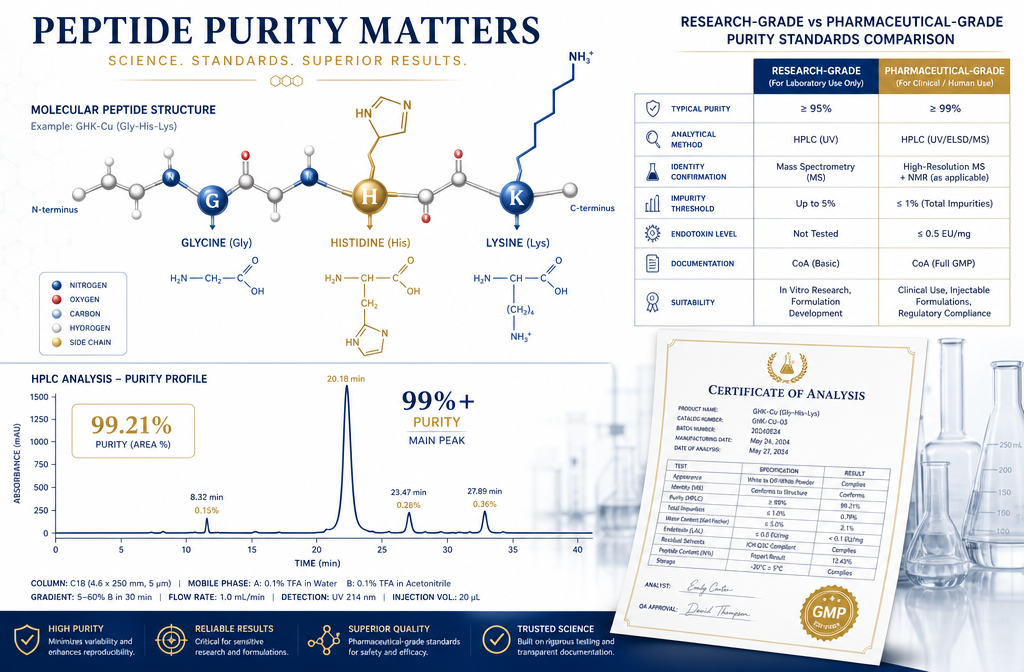
Purity is not a self-reported metric. Credible suppliers use High-Performance Liquid Chromatography (HPLC) as the primary analytical method. HPLC separates the components of a sample by their interaction with a stationary phase and a mobile phase, producing a chromatogram in which each compound appears as a distinct peak. The area under the target compound’s peak, expressed as a percentage of total peak area, gives the purity figure. Some suppliers complement HPLC with mass spectrometry (MS) to confirm molecular identity alongside purity [1][4].
Several factors determine whether a batch reaches the 99% threshold:
- Synthesis method: Solid-phase peptide synthesis (SPPS) is the standard approach; the quality of reagents and coupling efficiency at each step directly affects the final purity
- Purification steps: Reverse-phase HPLC purification after synthesis removes the majority of truncated sequences and by-products
- Handling and packaging: Exposure to moisture, oxygen, or light after synthesis can degrade the compound before testing is even complete; reputable suppliers seal products under inert gas (such as argon) before dispatch [3]
- Batch-specific testing: Purity must be verified per batch, not per compound class — a supplier’s general claim of “99% purity” is only meaningful if supported by batch-specific CoA documentation
Sempica verifies all compounds to a 99.8% purity standard through independent third-party testing, with CoAs available for every product in the catalogue.
How Do Pharmaceutical-Grade Peptides Compare to Research-Grade Peptides?
Research-grade and pharmaceutical-grade peptides share the same fundamental chemistry, but differ significantly in regulatory oversight, manufacturing environment, and intended use. Research-grade peptides at 99%+ purity are produced under controlled laboratory conditions with analytical verification; pharmaceutical-grade compounds are manufactured under Good Manufacturing Practice (GMP) regulations, with full regulatory documentation, validated manufacturing processes, and approval for human administration.
For laboratory research purposes, 99% purity research peptides are entirely appropriate. The key practical differences are:
| Attribute | Research-Grade (99%+) | Pharmaceutical-Grade (GMP) |
|---|---|---|
| Intended use | Laboratory research only | Human therapeutic use |
| Purity standard | ≥99% (HPLC verified) | ≥99% + full GMP validation |
| Regulatory oversight | Supplier QC + third-party testing | National medicines authority approval |
| CoA provided | Yes, batch-specific | Yes, with full GMP documentation |
| Cost | Lower | Significantly higher |
| Availability | Direct from research suppliers | Prescription/clinical channels only |
For preclinical research, in vitro assays, and mechanistic studies, research-grade compounds at verified 99%+ purity provide the analytical confidence needed for valid results [2][6]. Pharmaceutical-grade compounds are required only when the research pathway involves regulatory submission or direct human administration — which falls entirely outside the scope of research peptide supply.
Which Research Fields Use Peptides Most Frequently?
Peptide research spans multiple scientific disciplines, with the highest activity currently concentrated in metabolic biology, cellular regeneration, longevity science, and neuroscience. These fields rely on synthetic peptides because they offer precise receptor targeting, defined pharmacokinetics, and reproducible activity profiles that small molecules cannot always replicate.
Metabolic research is one of the most active areas in 2026. GLP-1 receptor agonists such as Semaglutide, dual agonists like Tirzepatide, and triple-pathway compounds such as Retatrutide are central to investigations into insulin sensitivity, appetite regulation, and energy expenditure. Sempica’s GLP-1/GIP multi-pathway metabolic research peptides resource provides detailed context on these compound classes.
Cellular regeneration research uses peptides including BPC-157 and TB-500 to investigate angiogenesis, tissue remodelling, and wound healing mechanisms. Longevity research employs compounds such as Epithalon (for telomere biology) and NAD+ (for mitochondrial function and sirtuin activation). Neuroscience and cognitive research uses peptides like Semax and Selank to explore neuroprotective and anxiolytic pathways.
For researchers working in endocrine biology, the endocrine and growth hormone research compounds section covers growth hormone secretagogues including Sermorelin, CJC-1295, and Ipamorelin.
Which Peptides Are Best for Molecular Biology Experiments?
The most appropriate peptide depends entirely on the research question. For molecular biology specifically, the most commonly used research peptides fall into categories based on the pathway under investigation.
For receptor binding and signal transduction studies, GLP-1 agonists (Semaglutide, Tirzepatide) and melanocortin peptides (Melanotan II, PT-141) are well-characterised tools with extensive published mechanistic data. For tissue repair and extracellular matrix research, BPC-157 and GHK-Cu are among the most studied compounds, with documented effects on FAK-paxillin signalling and matrix metalloproteinase regulation respectively. For mitochondrial and metabolic pathway research, MOTS-c (which activates AMPK signalling) and NAD+ (essential for PARP-mediated DNA repair and sirtuin activity) are the primary compounds of interest.
A practical selection framework:
- Choose BPC-157 for gastrointestinal mucosal repair, tendon healing, or neurological recovery models
- Choose Epithalon for telomere biology or pineal gland function research — see the Epithalon 20mg research compound for specifications
- Choose Semaglutide for insulin resistance, appetite regulation, or cardiovascular outcome models
- Choose Semax for neuroprotective or cognitive function investigations — the Semax 20mg compound is formulated for exactly these applications
- Choose NAD+ for cellular ageing, DNA repair, or mitochondrial dysfunction studies; Sempica’s NAD+ and anti-aging research guide covers the mechanistic detail
Where Can Researchers Legally Source 99% Purity Research Peptides for Lab Work?
Qualified research professionals can source 99% purity research peptides from specialist research compound suppliers who provide independent CoA documentation, HPLC-verified purity data, and clear research-use-only terms. The legal framework varies by jurisdiction, but in most countries, the purchase of research peptides by qualified professionals for laboratory use is permitted provided the compounds are not intended for human consumption.
When evaluating a supplier, the following criteria are non-negotiable:
- Batch-specific Certificate of Analysis from an independent third-party laboratory — not an in-house document
- HPLC purity data confirming ≥99% for the specific batch being purchased [1][2][5][7]
- Clear research-use-only terms with no implication of human or therapeutic use
- Transparent sourcing and manufacturing information
- Responsive technical support for reconstitution and storage queries
Sempica Healthcare (sempicahealthcare.ch) ships to 50+ countries, maintains a 99.8% purity standard across all compounds, and provides CoAs for every product. The guide to buying genuine peptides online for laboratory use covers the sourcing process in detail.
Other verified suppliers in the market include Solstice Sciences (reporting an average purity of 99.4% across 1,248 HPLC-tested batches) [3], PeptiGenetix (guaranteeing 99.5%+ HPLC purity with independent verification) [4], and Helios Peptides (batch-traceable CoAs with every order) [6].
How Much Do High-Purity Peptides Cost for Scientific Research?
Pricing for 99% purity research peptides varies considerably based on compound complexity, molecular weight, synthesis difficulty, and batch size. As a general guide for 2026, straightforward peptides (5–15 amino acids) in milligram quantities typically range from $20 to $80 per vial, while more complex compounds — particularly long-chain acylated peptides like Semaglutide or Tirzepatide — command higher prices due to synthesis complexity and purification demands.
Factors that affect price:
- Amino acid chain length: Longer sequences require more synthesis steps and have lower yields, increasing cost
- Post-translational modifications: Acylation, cyclisation, or copper complexing (as in GHK-Cu) adds manufacturing complexity
- Batch quantity: Larger orders typically reduce per-unit cost
- Purity threshold: Compounds purified to 99.5%+ require more rigorous purification steps than those at 98%, which is reflected in price
- Third-party testing costs: Suppliers who invest in independent CoA documentation pass some of that cost to the buyer — this is a quality signal, not a markup to avoid
Researchers should treat unusually low prices as a red flag. A compound priced significantly below market rate for its class either lacks adequate purification, has not been independently tested, or both. The cost of a compromised experiment — in time, reagents, and data validity — far exceeds the savings from a cheaper, unverified batch [8][10].
What Equipment Is Required to Work with 99% Pure Research Peptides?
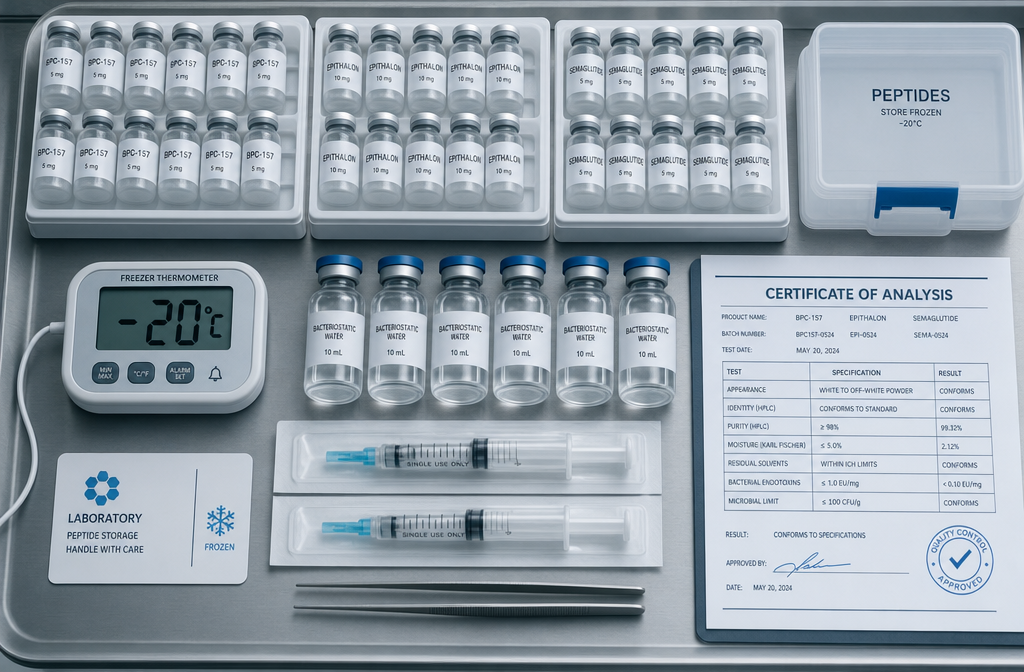
Working with high-purity research peptides requires a defined set of laboratory equipment to ensure safe handling, accurate reconstitution, and experimental validity. The equipment list is not extensive, but each item is functionally necessary.
For reconstitution and preparation:
- Precision analytical balance (capable of measuring to 0.001g)
- Sterile syringes (typically 1mL insulin-type for small volumes)
- Bacteriostatic water (0.9% benzyl alcohol) for multi-use reconstitution
- Sterile water for single-use applications only
- Alcohol swabs for vial septum sterilisation
- Labelling materials with reconstitution date and concentration
For storage:
- -20°C laboratory freezer for unreconstituted lyophilised powder
- 2–8°C refrigerator for reconstituted solutions (use within 28 days)
- Light-proof storage containers or amber vials for light-sensitive compounds (e.g., Melanotan II, NAD+)
For quality verification:
- Access to HPLC equipment or a verified CoA from the supplier confirming batch purity
- Laboratory notebook or digital records system for batch traceability
The comprehensive laboratory guide to mixing and storing peptides provides step-by-step reconstitution protocols and storage specifications for the most common research compounds.
What Storage Conditions Do Research Peptides Require?
Lyophilised research peptides must be stored at -20°C in a dry, dark environment until use. Once reconstituted, solutions should be kept at 2–8°C and used within 28 days for most compounds. Never freeze a reconstituted solution, as ice crystal formation damages peptide structure and degrades potency.
The specific storage requirements by compound state:
| State | Temperature | Light Sensitivity | Shelf Life |
|---|---|---|---|
| Lyophilised powder | -20°C | Moderate | Until expiry date |
| Reconstituted (bacteriostatic water) | 2–8°C | Varies by compound | Up to 28 days |
| Reconstituted (sterile water) | 2–8°C | Varies by compound | Up to 24 hours |
| In transit (sealed) | Ambient (short-term) | Protected | Per supplier protocol |
Compounds with particular sensitivity include NAD+ (highly sensitive to both light and moisture — store in amber vials), Melanotan II (protect from light at all times), and GHK-Cu (copper complexation can be affected by prolonged exposure to air). Repeated freeze-thaw cycles are damaging for all peptide compounds and should be avoided by aliquoting reconstituted solutions into single-use volumes where possible.
What Are the Most Common Mistakes When Handling Research Peptides?
The most consequential mistakes in peptide research occur during reconstitution and storage, not during the experiment itself. Errors at these stages introduce variables that cannot be corrected downstream.
The five most common handling errors:
- Injecting water directly onto the lyophilised powder — this creates turbulence that can break peptide bonds. Always inject bacteriostatic water slowly down the inside wall of the vial and allow the powder to dissolve by gentle swirling
- Shaking or vortexing the reconstituted solution — mechanical agitation denatures peptides. Swirl gently; never shake
- Storing reconstituted solutions in the freezer — ice crystal formation physically damages peptide chains. Reconstituted solutions belong in the refrigerator, not the freezer
- Failing to label vials with reconstitution date and concentration — without this information, concentration calculations become unreliable and batch traceability is lost
- Purchasing compounds without a CoA — using unverified peptides introduces unknown impurities that can confound results and make data unreproducible [9][10]
A secondary but important error is calculating concentration incorrectly. The formula is straightforward: Concentration (mg/mL) = Peptide mass (mg) ÷ Volume of diluent added (mL). Adding 2mL of bacteriostatic water to a 10mg vial yields a 5mg/mL solution. Errors here propagate through every downstream dosing calculation in the experiment.
How Do Researchers Verify the Purity of a Peptide Sample?
Purity verification relies on the Certificate of Analysis (CoA) provided by an independent testing laboratory. A valid CoA will specify the compound name, batch number, testing date, analytical method (HPLC with detection wavelength), and the resulting purity percentage. Researchers should cross-reference the batch number on the CoA with the batch number on the vial to confirm the document applies to the specific product received [1][6].
For laboratories with access to HPLC instrumentation, in-house verification is possible and provides an additional layer of confidence. The procedure involves dissolving a small aliquot of the compound in an appropriate solvent, injecting it into the HPLC system, and comparing the resulting chromatogram against a reference standard. A purity of ≥99% is confirmed when the target compound’s peak area represents at least 99% of total integrated peak area.
Researchers without in-house HPLC access can send samples to independent contract analytical laboratories for third-party verification. This is particularly advisable when working with novel compounds, large batch quantities, or research protocols where data integrity is subject to external review.
A CoA from the supplier is the minimum standard. An independent in-house or third-party HPLC result is the gold standard.
Are Research Peptides Safe to Use in Academic and Laboratory Settings?
When handled according to standard laboratory safety protocols, 99% purity research peptides present a manageable risk profile for qualified professionals working in controlled settings. The primary safety considerations are not unique to peptides — they apply to all synthetic compounds handled in a research environment.
Standard precautions include:
- Wearing appropriate PPE (gloves, eye protection, lab coat) during reconstitution and handling
- Working in a laminar flow hood or clean bench when sterility is required
- Consulting the compound’s safety data sheet (SDS) for specific handling, disposal, and first-aid guidance
- Following institutional biosafety and chemical safety protocols
Critical compliance note: These compounds are not safe for human consumption, self-administration, or any use outside a controlled laboratory setting. This is not a precautionary disclaimer — it is a regulatory and scientific fact. Research peptides are not tested for human safety or efficacy through the clinical trial process. Any use outside a qualified laboratory context is outside the scope of their supply classification and carries unknown risks.
All products available through Sempica Healthcare are supplied strictly for research use by qualified professionals. This position is maintained without exception across all content and transactions.
Frequently Asked Questions
Q: What is the minimum acceptable purity for a research peptide to be scientifically useful?
A: Most published preclinical research uses compounds at ≥98% purity as a baseline, but 99%+ is the current standard for reproducible results. At lower purity levels, impurities can interact with assay reagents or biological targets, producing confounding data [1][4].
Q: What does a Certificate of Analysis actually confirm?
A: A CoA confirms the compound’s identity, molecular weight, purity percentage, testing method (typically HPLC), and the batch number tested. It is issued by an independent laboratory, not the supplier, and is specific to a single production batch [2][6].
Q: Can bacteriostatic water be substituted with sterile saline for reconstitution?
A: Sterile saline (0.9% sodium chloride) can be used for reconstitution, but it offers no antimicrobial protection. Reconstituted solutions in sterile saline should be treated as single-use and discarded within 24 hours. Bacteriostatic water is preferred for multi-use vials.
Q: How long does lyophilised peptide powder remain stable?
A: When stored at -20°C in a sealed vial, away from light and moisture, most lyophilised research peptides remain stable until the supplier’s stated expiry date — typically 12–24 months from manufacture. Stability varies by compound; NAD+ and certain oxidation-sensitive peptides have shorter shelf lives.
Q: Is it legal to purchase research peptides in Europe?
A: Regulatory status varies by country. In most European jurisdictions, qualified research professionals can purchase synthetic peptides for laboratory use. Researchers should verify the specific regulatory framework in their country before ordering. Sempica Healthcare ships to 50+ countries and can provide guidance through the contact page.
Q: What is the difference between a peptide and a small molecule in research?
A: Peptides are chains of amino acids (typically 2–50 residues) with relatively high molecular weights and specific receptor-binding profiles. Small molecules are low molecular weight organic compounds (typically <500 Da) that interact with targets through different binding mechanisms. Both are used in research, but they require different synthesis, handling, and analytical approaches.
Q: How should researchers dispose of unused research peptides?
A: Unused peptides should be disposed of according to institutional chemical waste protocols and local regulations. Reconstituted solutions should not be poured down laboratory drains without confirming this is compliant with local waste disposal rules. Consult your institution’s biosafety or environmental health and safety office.
Q: Does higher purity always mean better research outcomes?
A: Higher purity reduces the risk of impurity-driven confounding variables, which generally improves data quality and reproducibility. However, purity alone does not guarantee experimental success — correct reconstitution, accurate dosing, appropriate experimental design, and proper controls are equally important.
Conclusion: Building a Reliable Research Peptide Protocol
The quality of research data is only as reliable as the compounds used to generate it. 99% purity research peptides, verified by independent HPLC analysis and supplied with batch-specific CoA documentation, provide the analytical foundation that reproducible science requires.
Actionable next steps for research professionals:
- Verify purity documentation before using any compound — request a batch-specific CoA and confirm the testing methodology is HPLC-based
- Establish correct storage immediately upon receipt: -20°C for lyophilised powder, 2–8°C for reconstituted solutions
- Follow reconstitution protocol precisely — inject bacteriostatic water down the vial wall, swirl gently, label with date and concentration
- Source from suppliers with transparent third-party testing — Sempica’s full research compound catalogue lists all available compounds with purity specifications
- Stay within the research-use-only framework — all use must occur within a qualified laboratory setting by a credentialed professional
For researchers working across metabolic, longevity, regeneration, or performance research areas, Sempica Healthcare’s catalogue of 1,000+ compounds — all verified to 99.8% purity — provides the sourcing reliability that advanced research demands. Explore the full range at sempicahealthcare.ch.
Research Use Only Disclaimer: All products referenced in this article are intended for research purposes only. They are not for human consumption, medical use, or therapeutic application. By purchasing from this website, you confirm that you are a qualified professional and will use these products strictly for laboratory research.
References
[1] Y&P Labs – https://ynplabs.com/?utm_source=openai
[2] Ignite Peptides – https://ignitepeptides.com/?utm_source=openai
[3] Solstice Sciences – https://www.solsticesciences.com/?utm_source=openai
[4] PeptiGenetix – https://peptigenetix.com/?utm_source=openai
[5] ARG Peptides – https://argpeptides.com/?utm_source=openai
[6] Helios Peptides – https://heliospeptides.com/?utm_source=openai
[7] Optides – https://optides.com/?utm_source=openai
[8] Prime Peptide Solutions – https://primepepsolutions.com/?utm_source=openai
[9] Lucid Labs – https://www.getlucidlabs.com/?utm_source=openai
[10] IDUN Peptides – https://idunpeptides.com/?utm_source=openai