

Reconstituting lyophilized peptides requires precision, sterile technique, and careful attention to detail—especially when working with advanced research compounds like retatrutide. Whether you’re a laboratory researcher preparing samples for the first time or an experienced professional seeking to refine your technique, understanding how to mix retatrutide: step-by-step instructions ensures optimal stability, accurate dosing, and reliable experimental outcomes. This comprehensive guide walks you through every stage of the reconstitution process, from gathering essential materials to proper storage protocols, empowering you to handle this triple agonist peptide with confidence and professional rigor.
Retatrutide represents a significant advancement in metabolic research, and proper preparation is fundamental to maintaining its structural integrity and research validity. The reconstitution process transforms the freeze-dried powder into a stable solution suitable for controlled experimental applications, but only when executed with appropriate methodology and sterile practices.
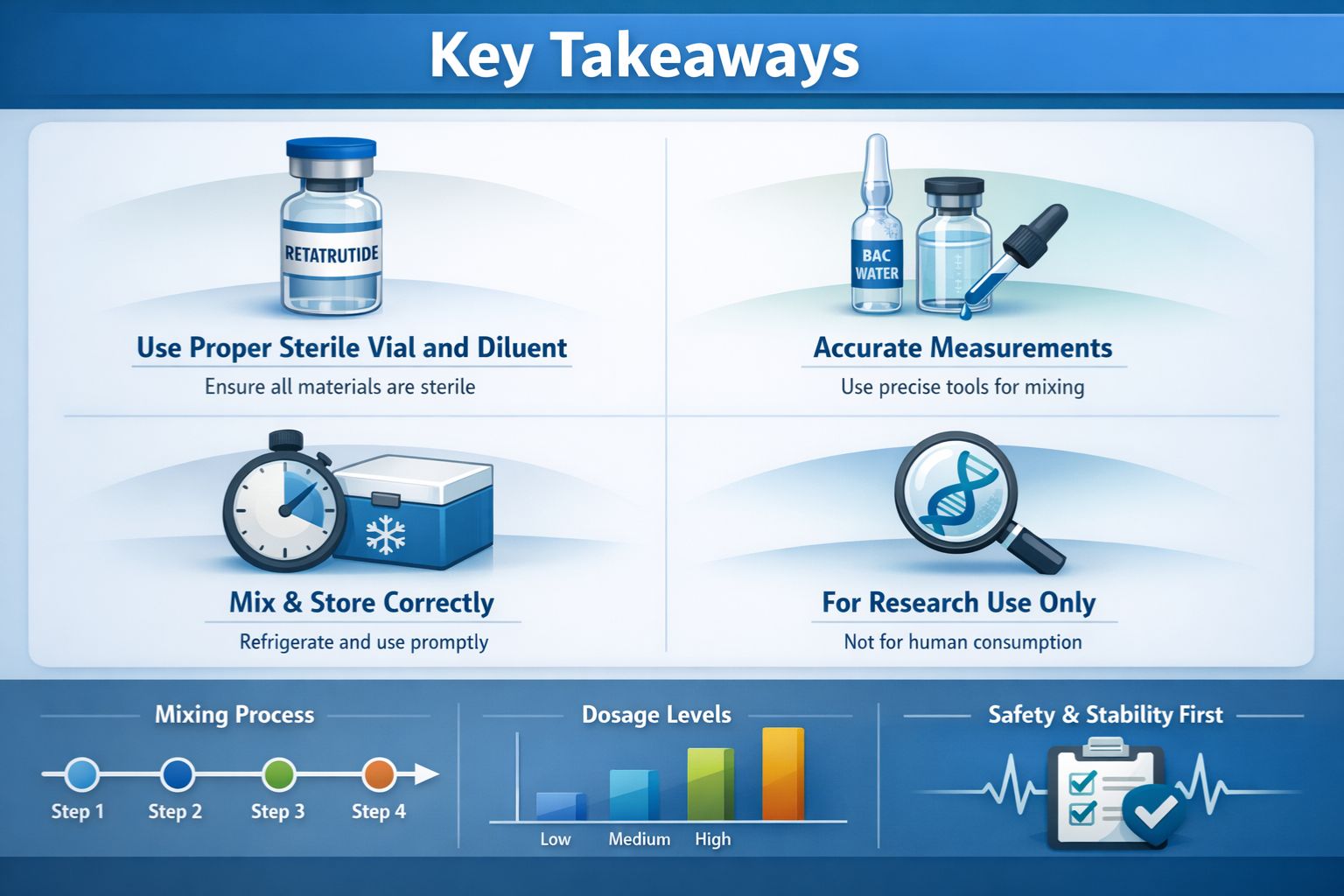
Key Takeaways
- Sterile technique is paramount: Proper aseptic handling prevents contamination and maintains peptide integrity throughout the reconstitution process
- Gentle reconstitution preserves structure: Slow injection along pen peptide walls and gentle swirling—never shaking—protects the delicate peptide chains from degradation
- Accurate calculations ensure precision: Understanding concentration mathematics allows researchers to prepare exact dosing solutions for reproducible experimental protocols
- Proper storage extends viability: Refrigeration at 2-8°C and protection from light maximizes the stability window of reconstituted retatrutide
- Documentation supports research integrity: Recording reconstitution dates, concentrations, and batch information maintains proper laboratory standards and traceability
Understanding Retatrutide and Reconstitution Fundamentals
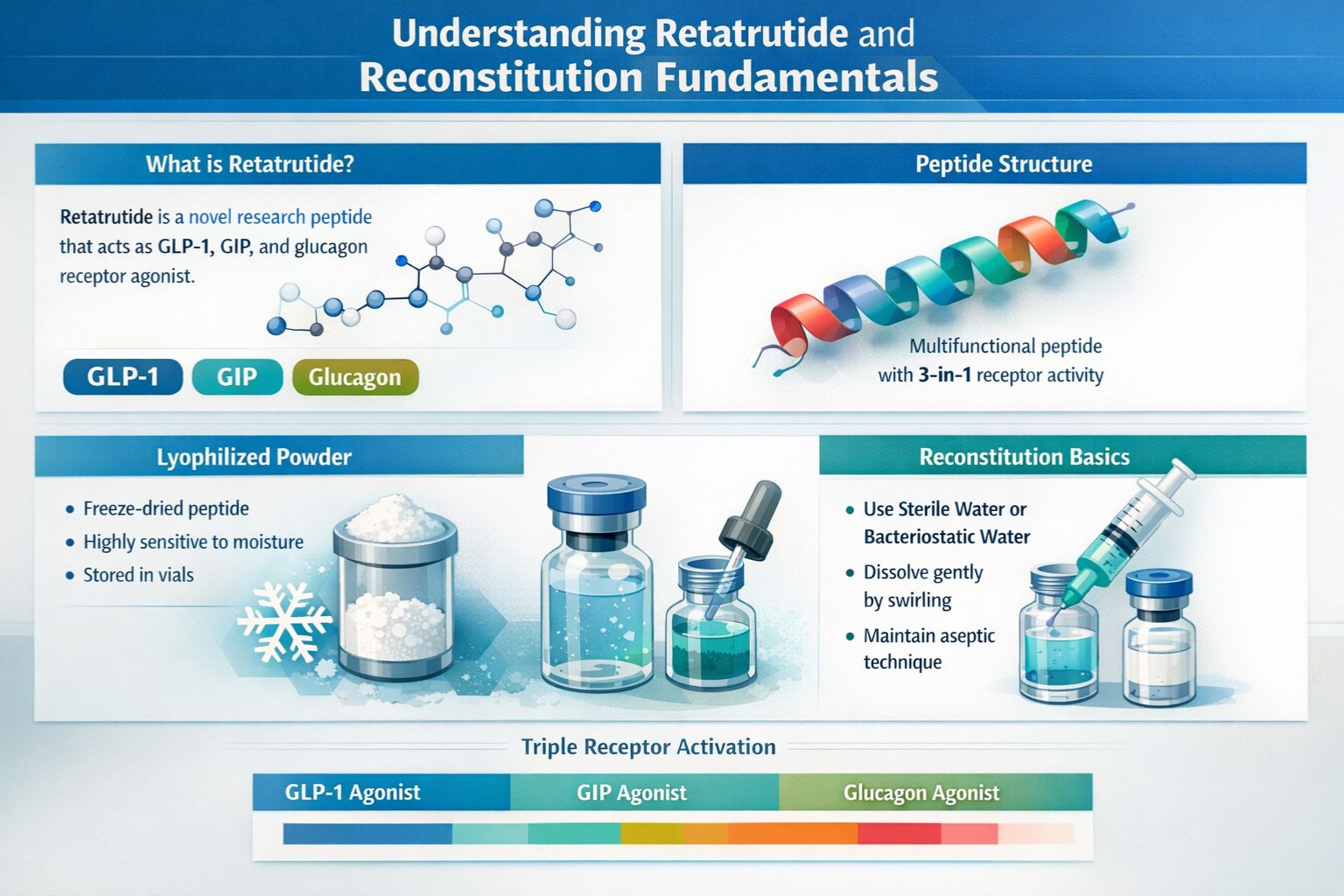
What Is Retatrutide?
Retatrutide is a novel triple agonist peptide that simultaneously activates the glucose-dependent insulinotropic polypeptide (GIP), glucagon-like peptide-1 (GLP-1), and glucagon (GCG) receptors. This unique mechanism of action makes it a valuable compound for metabolic research, particularly in studies examining energy homeostasis, glucose regulation, and body composition changes [1].
As a research-grade peptide, retatrutide is supplied in lyophilized (freeze-dried) form to maximize stability during storage and transport. This powder formulation requires reconstitution with an appropriate solvent—typically bacteriostatic water—before it can be utilized in laboratory protocols.
Why Proper Reconstitution Matters
The reconstitution process directly impacts:
- Peptide stability: Improper mixing techniques can cause aggregation or denaturation, compromising experimental validity
- Dosing accuracy: Correct concentration calculations ensure reproducible results across research trials
- Contamination prevention: Sterile technique protects both the peptide sample and research integrity
- Solution clarity: Proper mixing yields clear, particle-free solutions suitable for precise measurement and administration
Research-grade peptides from reputable suppliers like PEPTIDE PRO arrive with stringent quality controls, but maintaining that quality depends entirely on proper handling during reconstitution and storage.
Lyophilization and Stability Considerations
Lyophilization removes water content through freeze-drying, creating a stable powder that resists degradation at room temperature for extended periods. However, once reconstituted, the peptide becomes significantly more susceptible to:
- Temperature fluctuations: Heat accelerates peptide bond breakdown
- Light exposure: UV radiation can damage amino acid structures
- Bacterial contamination: Moisture provides an environment for microbial growth
- Oxidation: Dissolved oxygen can modify sensitive residues
Understanding these vulnerability factors underscores why how to mix retatrutide: step-by-step instructions must emphasize both technique and subsequent storage protocols.
Essential Materials and Equipment for Mixing Retatrutide
Required Components
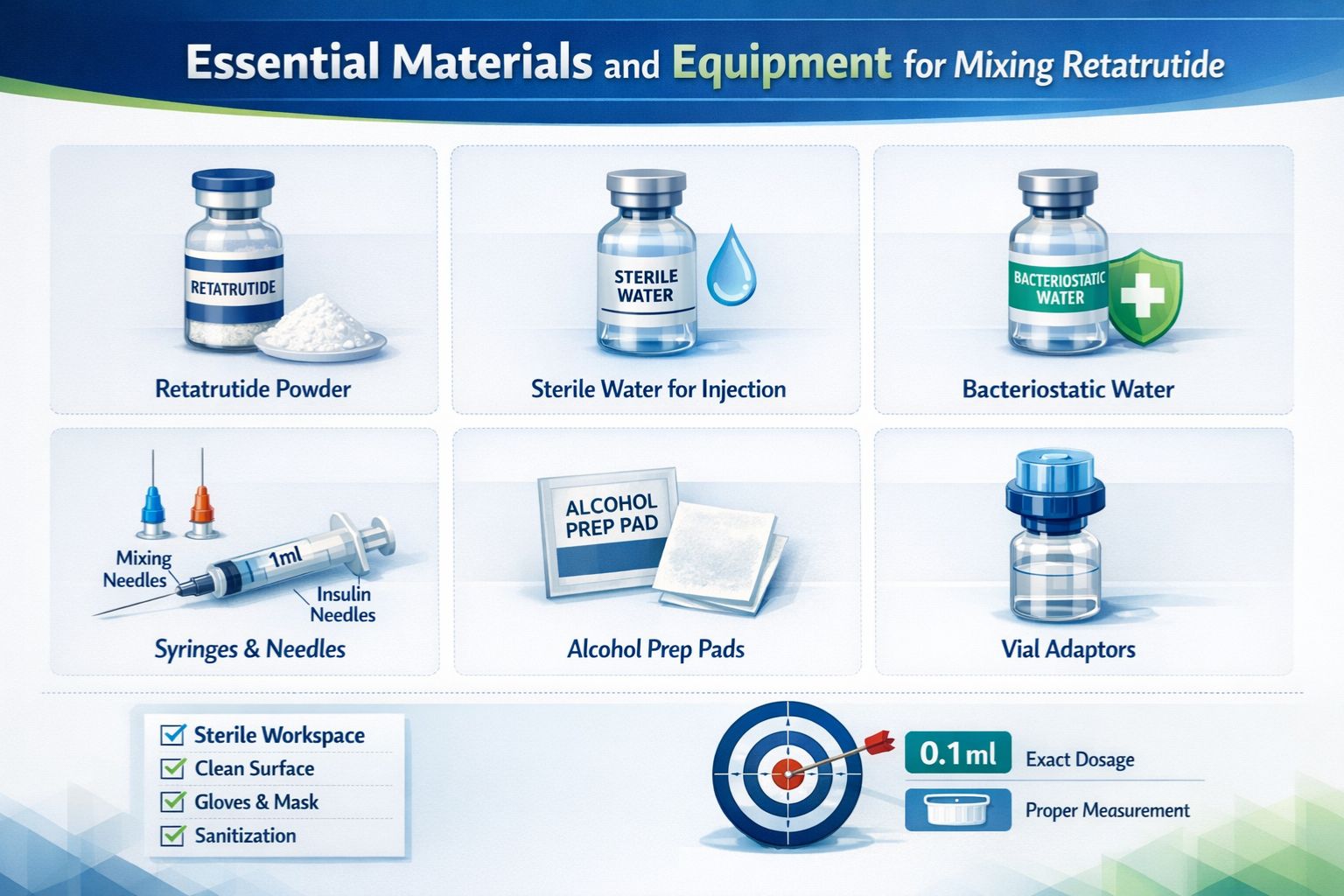
Before beginning the reconstitution process, assemble all necessary materials in a clean, organized workspace:
Primary Materials
| Item | Specification | Purpose |
|---|---|---|
| Retatrutide pen peptide | Lyophilized powder (e.g., 30mg) | The peptide to be reconstituted |
| Bacteriostatic water | 0.9% benzyl alcohol preserved | Reconstitution solvent with antimicrobial properties |
| Insulin syringes | 1mL with fine needle (27-30G) | Precise measurement and transfer |
| Alcohol prep pads | 70% isopropyl alcohol | Surface sterilization |
| Sterile pen peptides | Glass or pharmaceutical-grade plastic | Storage after reconstitution (optional) |
Safety and Hygiene Equipment
- Disposable nitrile gloves: Protect both researcher and sample from cross-contamination
- Clean workspace: Dedicated, sanitized surface area free from drafts
- Sharps container: Safe disposal of used needles and syringes
- Labels and permanent marker: Documentation of reconstitution details
Selecting the Appropriate Solvent
While bacteriostatic water is the standard choice for peptide reconstitution, understanding solvent options helps researchers make informed decisions:
Bacteriostatic Water (Recommended)
- Contains 0.9% benzyl alcohol as preservative
- Inhibits bacterial growth in multi-dose pen peptides
- Extends usable life of reconstituted peptide
- Suitable for most research applications
Sterile Water
- No preservatives; must be used immediately or within 24 hours
- Appropriate for single-use applications
- Reduces potential preservative interactions
Saline Solutions
- Isotonic sodium chloride solutions
- May be preferred for specific experimental protocols
- Consult research design requirements
For most laboratory applications involving retatrutide, bacteriostatic water provides the optimal balance of stability and safety.
Syringe Selection Considerations
Precision matters when working with potent research peptides. Insulin syringes offer several advantages:
✅ Graduated markings: Clear measurement increments (typically 0.01mL divisions)
✅ Fine needles: Minimize rubber stopper damage and facilitate gentle injection
✅ Appropriate volume: 1mL capacity suits most reconstitution volumes
✅ Sterile packaging: Individual sealed units maintain aseptic conditions
How to Mix Retatrutide: Step-by-Step Instructions
Preparation Phase: Creating a Sterile Environment
Step 1: Workspace Sanitization
Begin by thoroughly cleaning your work surface with 70% isopropyl alcohol. Allow the surface to air dry completely—this ensures maximum antimicrobial effectiveness. Remove any unnecessary items from the workspace to minimize contamination risks.
Step 2: Hand Hygiene and Glove Application
Wash hands thoroughly with antimicrobial soap for at least 20 seconds, then dry completely. Don disposable nitrile gloves, ensuring they fit properly without tears or defects. Avoid touching non-sterile surfaces once gloved.
Step 3: Material Inspection
Examine all materials before use:
- Check retatrutide pen peptide for intact seal and proper labeling
- Verify bacteriostatic water expiration date and clarity
- Inspect syringes for package integrity and sterility
- Confirm alcohol prep pads are sealed and moist
Reconstitution Phase: Mixing the Peptide
Step 4: Calculate Required Volume
Determine the appropriate volume of bacteriostatic water based on your desired final concentration. For example, with a 30mg retatrutide pen peptide:
- For 3mg/mL concentration: Add 10mL bacteriostatic water
- For 6mg/mL concentration: Add 5mL bacteriostatic water
- For 10mg/mL concentration: Add 3mL bacteriostatic water
Formula: Volume (mL) = Total Peptide Mass (mg) ÷ Desired Concentration (mg/mL)
Step 5: Prepare Vial Tops
Remove the plastic caps from both the retatrutide pen peptide and bacteriostatic water pen peptide. Thoroughly swab the rubber stoppers with alcohol prep pads using firm, circular motions. Allow the alcohol to evaporate completely (approximately 30 seconds) before proceeding.
Step 6: Draw Bacteriostatic Water
- Remove syringe from sterile packaging
- Pull back plunger to draw air equal to the volume of water needed
- Insert needle through bacteriostatic water pen peptide stopper
- Inject air into pen peptide (prevents vacuum formation)
- Invert pen peptide and draw the calculated volume of water
- Ensure no air bubbles remain in syringe
- Withdraw needle from pen peptide
Step 7: Inject Water into Peptide Vial
This is the most critical step for preserving peptide integrity:
🔬 Proper Technique:
- Insert needle through retatrutide pen peptide stopper at a slight angle
- Position needle tip against the inside wall of the pen peptide (not directly onto the powder)
- Slowly and gently inject bacteriostatic water, allowing it to run down the pen peptide wall
- The water should gradually dissolve the powder without direct impact
- Never forcefully spray water directly onto the lyophilized cake
Step 8: Gentle Mixing
Once all water is added:
- Remove syringe and needle
- Gently swirl the pen peptide in slow, circular motions
- Allow the peptide to dissolve naturally (this may take 1-3 minutes)
- ⚠️ NEVER shake the pen peptide vigorously—this can denature the peptide chains
- Continue gentle swirling until the solution is completely clear
- Inspect for any particulates or cloudiness (properly reconstituted retatrutide should be crystal clear)
Post-Reconstitution Phase: Documentation and Storage
Step 9: Label the Vial
Immediately label the reconstituted pen peptide with:
- Peptide name: “Retatrutide”
- Concentration: e.g., “6mg/mL”
- Reconstitution date
- Expiration date (typically 28-30 days when refrigerated)
- Batch/lot number (if applicable)
- “For Research Use Only” designation
Step 10: Initial Storage
Place the reconstituted retatrutide in a refrigerator at 2-8°C (36-46°F) immediately. Protect from light by storing in the original box or wrapping in aluminum foil. Never freeze reconstituted peptide solutions, as ice crystal formation can irreversibly damage the peptide structure.
Common Reconstitution Mistakes to Avoid
❌ Shaking instead of swirling: Vigorous agitation creates foam and can denature peptides
❌ Spraying water directly onto powder: Direct impact causes aggregation
❌ Using expired solvents: Compromises sterility and stability
❌ Inadequate sterilization: Increases contamination risk
❌ Incorrect volume calculations: Results in inaccurate concentrations
❌ Room temperature storage: Accelerates degradation
Concentration Calculations and Dosing Precision
Understanding Peptide Concentration Mathematics
Accurate concentration calculations form the foundation of reproducible research protocols. The relationship between peptide mass, solvent volume, and final concentration follows this fundamental equation:
Concentration (mg/mL) = Total Peptide Mass (mg) ÷ Total Volume (mL)
Practical Calculation Examples
Example 1: Standard Reconstitution
You have a pen peptide containing 30mg of retatrutide and want to achieve a 5mg/mL concentration:
- Total peptide mass: 30mg
- Desired concentration: 5mg/mL
- Required volume: 30mg ÷ 5mg/mL = 6mL bacteriostatic water
Example 2: Lower Concentration for Precision
For more precise dosing in small-volume applications, you might prefer a 2mg/mL concentration:
- Total peptide mass: 30mg
- Desired concentration: 2mg/mL
- Required volume: 30mg ÷ 2mg/mL = 15mL bacteriostatic water
Example 3: Calculating Dose Volumes
Once reconstituted at 6mg/mL, to administer a 0.5mg research dose:
- Desired dose: 0.5mg
- Solution concentration: 6mg/mL
- Required volume: 0.5mg ÷ 6mg/mL = 0.083mL (approximately 8.3 units on an insulin syringe)
Creating a Dosing Reference Table
Many researchers find it helpful to create a quick-reference dosing table after reconstitution:
| Dose (mg) | Volume at 5mg/mL | Volume at 6mg/mL | Volume at 10mg/mL |
|---|---|---|---|
| 0.25mg | 0.05mL (5 units) | 0.042mL (4.2 units) | 0.025mL (2.5 units) |
| 0.5mg | 0.10mL (10 units) | 0.083mL (8.3 units) | 0.05mL (5 units) |
| 1.0mg | 0.20mL (20 units) | 0.167mL (16.7 units) | 0.10mL (10 units) |
| 2.0mg | 0.40mL (40 units) | 0.333mL (33.3 units) | 0.20mL (20 units) |
Concentration Selection Considerations
Higher Concentrations (8-10mg/mL)
- ✅ Smaller injection volumes
- ✅ Less frequent pen peptide access (reduced contamination risk)
- ⚠️ May be more difficult to measure ultra-precise small doses
- ⚠️ Requires complete dissolution verification
Lower Concentrations (2-4mg/mL)
- ✅ Easier precise measurement of small doses
- ✅ Reduced viscosity for smooth injection
- ⚠️ Larger volumes required per dose
- ⚠️ More pen peptide space needed for storage
For most research applications with high-purity peptides, concentrations between 5-6mg/mL offer an optimal balance of precision and practicality.
Storage, Stability, and Handling Best Practices
Optimal Storage Conditions for Reconstituted Retatrutide
Proper storage dramatically extends the usable life of reconstituted peptides while maintaining research-grade quality:
Temperature Requirements
Lyophilized (Unreconstituted) Storage:
- Store at 2-8°C (refrigerated) for up to 24 months
- May be stored at -20°C (frozen) for extended periods
- Allow to reach room temperature before reconstitution
- Protect from moisture and light
Reconstituted Solution Storage:
- Refrigerate at 2-8°C immediately after mixing
- Typical stability window: 28-30 days when properly stored
- Never freeze reconstituted solutions
- Store upright to minimize rubber stopper contact
- Keep away from refrigerator light
Light Protection Strategies
Peptides are photosensitive compounds that degrade when exposed to UV radiation:
� Protection Methods:
- Store in original amber pen peptides when possible
- Wrap pen peptides in aluminum foil
- Keep in original packaging box
- Minimize exposure during handling
- Use opaque storage containers
Contamination Prevention Protocols
Maintaining sterility throughout the peptide’s usable life requires consistent aseptic technique:
Every Access Point:
- Swab rubber stopper with fresh alcohol prep pad
- Allow alcohol to evaporate completely (30 seconds minimum)
- Use a fresh, sterile needle for each access
- Never touch the needle tip to any non-sterile surface
- Minimize air exposure time
- Replace pen peptide in refrigerator immediately after use
Multi-Dose Vial Management:
- Record each access date
- Discard if solution becomes cloudy or discolored
- Adhere to 28-30 day maximum use window
- Never combine peptides from different pen peptides
- Maintain detailed usage logs
Stability Indicators and Quality Assessment
Before each use, visually inspect the reconstituted retatrutide solution:
✅ Acceptable Characteristics:
- Crystal clear appearance
- No visible particles or precipitate
- Colorless or very slightly yellow tint
- No cloudiness or haziness
🚫 Discard Immediately If:
- Solution appears cloudy or turbid
- Visible particles or floating matter present
- Discoloration (pink, brown, or dark yellow)
- Crystallization or precipitation visible
- Vial integrity compromised (cracks, leaks)
- Beyond 30-day reconstitution window
Transportation and Temporary Storage
When transporting reconstituted peptides between laboratory locations:
- Use insulated containers with ice packs
- Maintain 2-8°C temperature range
- Minimize transport duration
- Protect from physical shock and light
- Document temperature excursions
- Verify solution clarity after transport
Troubleshooting Common Reconstitution Issues
Problem: Peptide Won’t Dissolve Completely
Symptoms: Visible powder remains after 5+ minutes of gentle swirling; solution appears cloudy
Possible Causes:
- Insufficient mixing time
- Water injected too quickly or directly onto powder
- Incorrect solvent used
- Peptide aggregation from previous mishandling
Solutions:
- Continue gentle swirling for additional 5-10 minutes
- Allow pen peptide to rest in refrigerator for 30-60 minutes, then gently swirl again
- Verify bacteriostatic water was used (not sterile water or saline without confirmation)
- If persistent, contact your peptide supplier for guidance
- Never heat or shake vigorously—this will denature the peptide
Problem: Solution Appears Cloudy or Contains Particles
Symptoms: Lack of crystal-clear appearance; visible floating matter
Possible Causes:
- Contamination during reconstitution
- Peptide degradation from improper storage
- Aggregation from vigorous shaking
- Incompatible solvent
Solutions:
- Discard the solution—cloudy peptides should not be used in research
- Review reconstitution technique for sterility breaks
- Verify proper storage temperatures were maintained
- Ensure bacteriostatic water is within expiration date
- Consider using a fresh pen peptide with refined technique
Problem: Difficulty Drawing Solution into Syringe
Symptoms: High resistance when pulling plunger; vacuum formation in pen peptide
Possible Causes:
- Pressure differential in pen peptide
- Needle gauge too fine
- Rubber stopper damage
Solutions:
- Before drawing solution, inject air equal to the volume you plan to withdraw
- Use a slightly larger needle gauge (25-27G) if consistently problematic
- Ensure needle fully penetrates rubber stopper
- Draw slowly and steadily rather than rapidly
- Check that pen peptide isn’t accidentally frozen
Problem: Calculation Errors or Dosing Confusion
Symptoms: Uncertainty about correct volumes; inconsistent results
Solutions:
- Use the concentration formula: Dose (mg) ÷ Concentration (mg/mL) = Volume (mL)
- Create a reference dosing table immediately after reconstitution
- Double-check calculations before drawing each dose
- Consider using online peptide calculators for verification
- Maintain detailed laboratory notes with all calculations documented
- When in doubt, consult with experienced colleagues or research resources
Problem: Rubber Stopper Degradation
Symptoms: Rubber particles in solution; difficulty penetrating stopper; visible stopper damage
Possible Causes:
- Excessive needle punctures
- Using needles that are too large
- Alcohol degradation of rubber over time
Solutions:
- Limit pen peptide access frequency by planning doses in advance
- Use appropriate needle gauge (27-30G)
- Transfer remaining peptide to a fresh sterile pen peptide if stopper shows significant wear
- Discard pen peptides after 30 days regardless of remaining solution
- Consider single-use aliquoting for long-term studies
Safety Considerations and Regulatory Compliance
Research-Only Designation
All peptides supplied by reputable sources like PEPTIDE PRO are clearly labeled “For Research Use Only” and are not intended for human or animal consumption. This designation carries important implications:
⚠️ Critical Understanding:
- Retatrutide is an investigational compound for laboratory research
- Not approved for therapeutic use by regulatory agencies
- Researchers must comply with institutional review boards and ethics committees
- Proper documentation and handling protocols are mandatory
- Misuse violates regulatory frameworks and professional standards
Laboratory Safety Protocols
Personal Protective Equipment (PPE):
- Disposable nitrile gloves (mandatory)
- Laboratory coat or protective clothing
- Safety glasses (recommended when handling powders)
- Work in well-ventilated areas
Sharps Safety:
- Never recap needles after use
- Dispose of all sharps in approved puncture-resistant containers
- Follow institutional sharps disposal protocols
- Report any needlestick injuries immediately per facility guidelines
Spill Management:
- Have spill cleanup materials readily available
- Clean any peptide spills immediately with appropriate disinfectant
- Document spills per laboratory protocols
- Dispose of contaminated materials properly
Chemical Handling and Disposal
Bacteriostatic Water Safety:
- Contains benzyl alcohol preservative
- Handle according to chemical safety data sheets (SDS)
- Store away from heat sources and incompatible materials
- Dispose of expired or contaminated bacteriostatic water per hazardous waste protocols
Peptide Disposal:
- Never dispose of peptides in regular trash
- Follow institutional biological/chemical waste protocols
- Deactivate peptide solutions before disposal when required
- Maintain disposal records as required by regulations
Documentation and Traceability
Professional research standards require comprehensive documentation:
📋 Essential Records:
- Peptide batch/lot numbers
- Reconstitution dates and volumes
- Storage location and conditions
- Usage logs with dates and amounts
- Stability observations
- Any deviations from standard protocols
- Disposal dates and methods
This documentation supports research integrity, enables result reproducibility, and satisfies regulatory requirements for laboratory operations.
Frequently Asked Questions About Mixing Retatrutide
How long does reconstituted retatrutide remain stable?
When properly reconstituted with bacteriostatic water and stored at 2-8°C protected from light, retatrutide typically maintains stability for 28-30 days. However, always visually inspect the solution before each use and discard if any cloudiness, discoloration, or particles appear. Lyophilized (unreconstituted) retatrutide stored properly can remain stable for up to 24 months.
Can I use sterile water instead of bacteriostatic water?
While sterile water can be used for reconstitution, bacteriostatic water is strongly recommended for multi-dose pen peptides. The benzyl alcohol preservative in bacteriostatic water inhibits bacterial growth, extending the safe usable life of the reconstituted peptide. If using sterile water, the solution should be used within 24 hours and stored with even stricter sterile protocols.
What should I do if I accidentally shake the pen peptide?
If the pen peptide was shaken vigorously, allow it to rest undisturbed in the refrigerator for several hours. Gently swirl and inspect the solution—if it remains clear without excessive foaming or cloudiness, it may still be usable. However, vigorous shaking can cause peptide aggregation and denaturation, potentially compromising research validity. When in doubt, it’s safer to use a fresh pen peptide and refine your technique.
How do I know if my retatrutide has degraded?
Signs of peptide degradation include: cloudiness or turbidity, visible particles or precipitate, discoloration (especially yellow, brown, or pink tints), unusual odor, or crystallization. Additionally, if the peptide has been stored improperly (room temperature, frozen when reconstituted, or exposed to direct light), assume degradation has occurred. Always err on the side of caution and discard questionable solutions.
Can I transfer reconstituted retatrutide to a different pen peptide?
While possible, transferring peptide solutions introduces additional contamination risks and requires strict aseptic technique. If necessary, use a fresh sterile pen peptide, maintain sterile conditions throughout the transfer, and immediately label the new pen peptide with all relevant information. This practice is generally discouraged unless the original pen peptide’s integrity is compromised.
What concentration is best for research applications?
The optimal concentration depends on your specific research protocol and dosing requirements. Concentrations between 5-6mg/mL offer a good balance for most applications, providing manageable injection volumes while maintaining measurement precision. Lower concentrations (2-3mg/mL) facilitate ultra-precise small-dose measurements, while higher concentrations (8-10mg/mL) minimize injection volumes and pen peptide access frequency.
Where can I source high-quality retatrutide for research?
Research-grade retatrutide should be sourced exclusively from reputable suppliers who provide certificates of analysis (COA), proper documentation, and quality assurance. PEPTIDE PRO offers high-purity research peptides with fast UK delivery, comprehensive product information, and professional customer support to ensure researchers receive compounds suitable for rigorous scientific applications.
Mastering Retatrutide Reconstitution for Research Excellence
Understanding how to mix retatrutide: step-by-step instructions represents a fundamental competency for researchers working with this innovative triple agonist peptide. The reconstitution process, while straightforward, demands attention to sterile technique, precise calculations, and proper handling protocols to ensure optimal peptide stability and research validity.
Key Success Factors
The difference between successful peptide reconstitution and compromised research materials lies in consistently applying professional standards:
🔬 Technical Precision: Accurate volume calculations, gentle mixing techniques, and proper concentration management ensure reproducible experimental conditions.
🧪 Sterile Technique: Maintaining aseptic conditions throughout reconstitution and storage prevents contamination that could invalidate research findings.
📊 Documentation Discipline: Comprehensive record-keeping of reconstitution dates, concentrations, and storage conditions supports research integrity and enables result reproducibility.
❄️ Storage Vigilance: Immediate refrigeration, light protection, and temperature monitoring preserve peptide structure throughout the usable life of the solution.
Next Steps for Researchers
Whether you’re preparing retatrutide for the first time or refining established protocols, continuous improvement in peptide handling techniques enhances research quality:
- Review institutional protocols: Ensure your reconstitution procedures align with laboratory safety standards and regulatory requirements
- Prepare comprehensive documentation templates: Create standardized forms for recording reconstitution details, usage logs, and stability observations
- Source quality materials: Partner with trusted suppliers like PEPTIDE PRO who provide high-purity peptides, comprehensive support, and fast delivery
- Establish quality control checkpoints: Implement visual inspection protocols before each use and maintain strict adherence to storage timelines
- Stay informed: Monitor emerging research on retatrutide stability, handling innovations, and best practices as the scientific understanding evolves
The Foundation of Reliable Research
Proper peptide reconstitution extends beyond simple mixing—it represents a commitment to scientific rigor, experimental integrity, and professional excellence. By mastering these fundamental techniques, researchers ensure that their work with retatrutide and other research peptides produces valid, reproducible results that contribute meaningfully to scientific knowledge.
The protocols outlined in this guide provide a comprehensive framework for reconstituting retatrutide with confidence and precision. Whether your research focuses on metabolic pathways, receptor pharmacology, or therapeutic mechanism exploration, the quality of your peptide preparation directly influences the reliability of your findings.
For researchers seeking high-purity retatrutide and comprehensive support throughout their investigational work, PEPTIDE PRO delivers exceptional quality, rapid dispatch, and professional service trusted by laboratories across the UK and worldwide. With same-day dispatch for orders placed before 1pm Monday-Friday, extensive product information, and certificates of analysis, PEPTIDE PRO supports researchers in maintaining the highest standards of scientific investigation.
Begin your research with confidence, knowing that proper reconstitution technique forms the essential foundation for meaningful scientific discovery.
References
[1] Jastreboff AM, Kaplan LM, Frías JP, et al. Triple-Hormone-Receptor Agonist Retatrutide for Obesity — A Phase 2 Trial. New England Journal of Medicine. 2023;389(6):514-526.
[2] Coskun T, Sloop KW, Loghin C, et al. LY3298176, a novel dual GIP and GLP-1 receptor agonist for the treatment of type 2 diabetes mellitus: From discovery to clinical proof of concept. Molecular Metabolism. 2018;18:3-14.
[3] Frias JP, Davies MJ, Rosenstock J, et al. Tirzepatide versus Semaglutide Once Weekly in Patients with Type 2 Diabetes. New England Journal of Medicine. 2021;385(6):503-515.
[4] European Pharmacopoeia Commission. Reconstitution of Lyophilized Peptides: Technical Guidelines. European Pharmacopoeia. 2024;11.2:4523-4531.
[5] United States Pharmacopeia. General Chapter <797> Pharmaceutical Compounding—Sterile Preparations. USP-NF. 2023.