

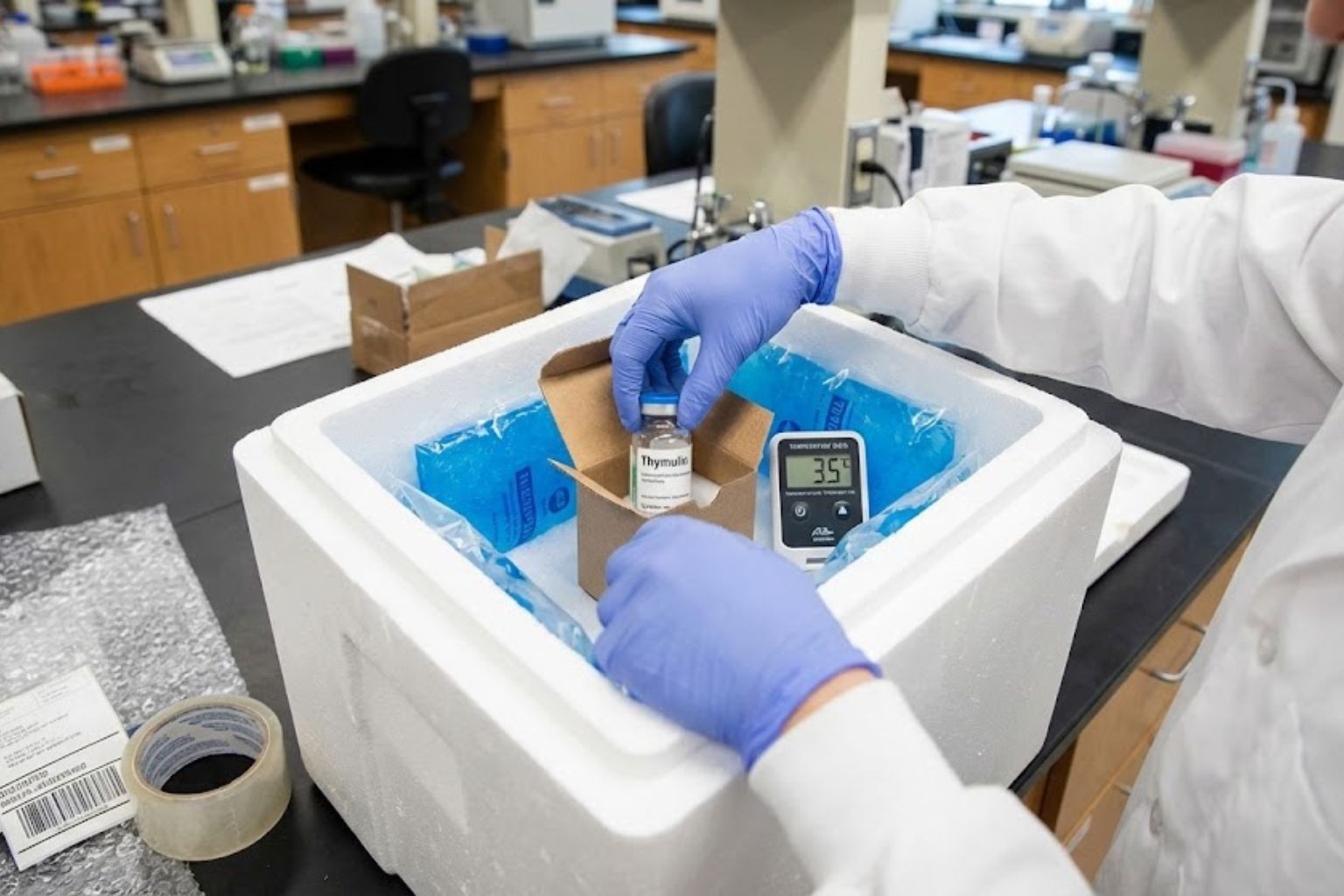
A Comprehensive Guide on Refrigeration, Travel & Expiry
In the precise and often unforgiving world of peptide research, data integrity is the currency of success. For researchers in the UK and globally who work with Thymulin (chemically known as Facteur Thymique Sérique or FTS), the margin for error regarding sample handling is incredibly slim. Unlike stable small molecules which can withstand minor environmental fluctuations, peptides are fragile biological chains that can unravel, oxidize, aggregate, or hydrolyse if treated with negligence.
Thymulin storage is not merely a logistical housekeeping detail; it is a mission-critical component of experimental design. Thymulin is unique among common research peptides because its biological activity is strictly dependent on the presence of Zinc ions.2 It exists as a metallopeptide. Improper storage doesn’t just degrade the primary peptide structure; it can disrupt the delicate coordinate covalent bonds between the peptide and the Zinc ion, rendering the molecule biologically inert before it is even introduced to a cell culture or assay.
Whether you are investigating its role in T-cell differentiation, evaluating its potential in immunomodulation, or studying neuroinflammation pathways, using degraded Thymulin guarantees reproducibility failures. It leads to “noisy” data, false negatives, and, ultimately, a wasted budget. This comprehensive guide covers everything a professional researcher needs to know about Thymulin storage, from the moment the lyophilised powder arrives at your facility to the complex logistics of international travel and expiry management.
1) Key Takeaways
For Principal Investigators (PIs) and Lab Managers who need to establish immediate protocols, here is the executive summary of the most operationally important rules for Thymulin storage. These points represent the non-negotiable pillars of peptide stability.
-
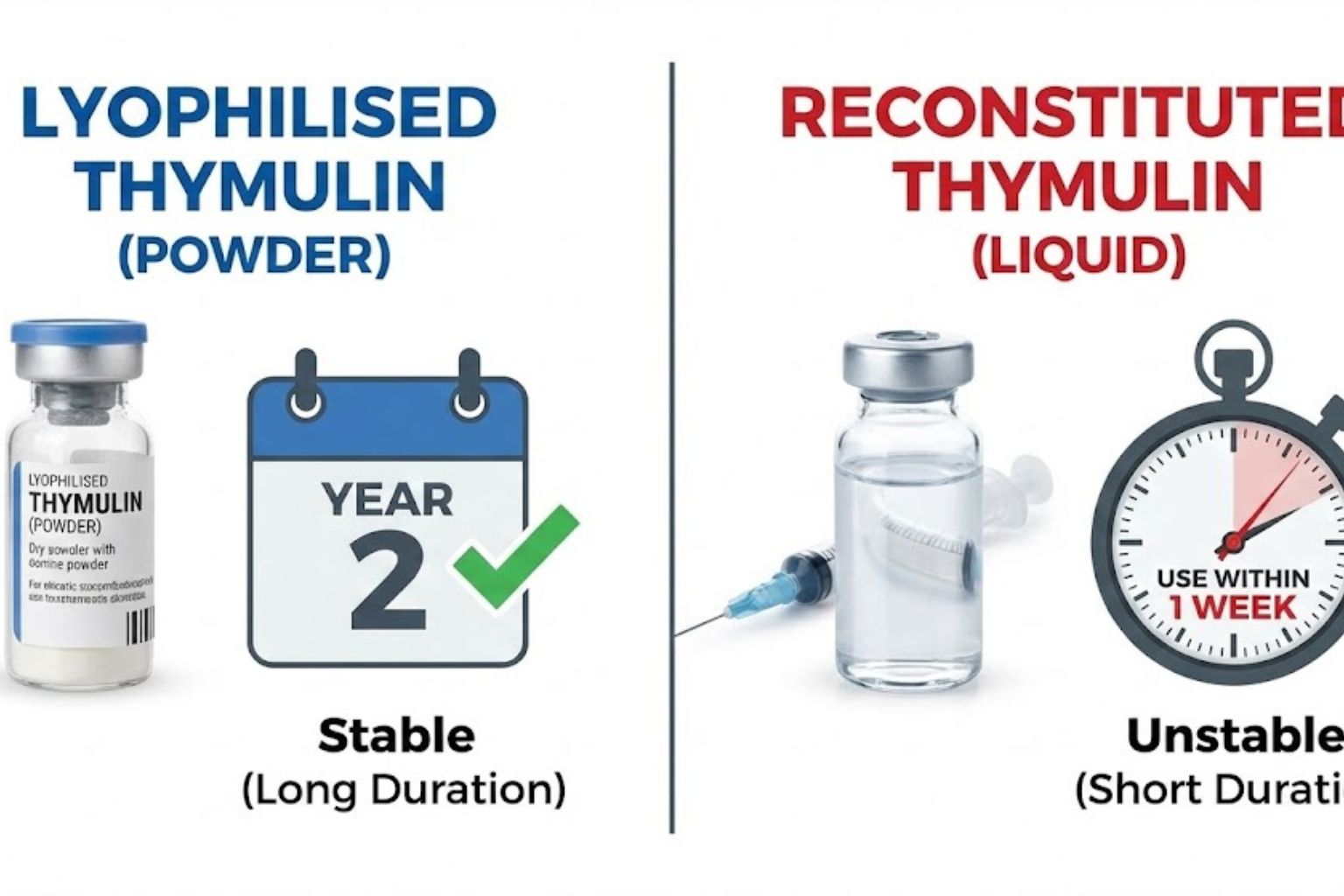
Lyophilised Stability: Upon receipt, store the freeze-dried powder at -20°C or lower. In this state, the peptide is suspended in a glass-like matrix that arrests chemical motility, allowing for long-term stability (up to 2 years).
-
Reconstituted Urgency: Once mixed with bacteriostatic water or a buffer, the clock starts ticking immediately. Reconstituted Thymulin is thermodynamically unstable and must be kept at 2–8°C. It should ideally be used within 1–2 weeks.
-
The Zinc Factor: Thymulin requires Zinc to be active (FTS-Zn).3 Ensure your solvent and storage conditions do not contain chelating agents (like EDTA) that strip Zinc from the peptide.
-
Travel Protocol: The “Cold Chain” must remain unbroken. Always transport Thymulin in an insulated cooler with frozen gel packs. Crucial: Never allow the pen peptides to touch ice or gel packs directly to prevent “frostbite” or thermal shock.
-
Freeze-Thaw Rule: Avoid repeated freeze-thaw cycles at all costs.4 Aliquot your solution immediately after reconstitution into single-use microcentrifuge tubes.
-
Visual Check: Perform a visual inspection before every use. If the solution turns cloudy, viscous, or develops particulates (precipitation), discard it immediately.
2) Understanding Thymulin Storage Fundamentals
To master the storage of this compound, one must understand the biochemistry of what Thymulin actually is. It is a nonapeptide (a specific chain of nine amino acids: Glp-Ala-Lys-Ser-Gln-Gly-Gly-Ser-Asn) originally isolated from the thymus gland.
The Zinc-Peptide Complex
Crucially, the nonapeptide chain alone (FTS) is biologically inactive. It functions as a carrier molecule. It only becomes the active hormone Thymulin when it binds to a Zinc ion (Zn²⁺) in a 1:1 equimolar ratio.
This structural reality dictates storage protocols. When we discuss protecting Thymulin, we are actually protecting two distinct structural elements:
-
The Peptide Chain: We must prevent the amide bonds between amino acids from breaking apart (hydrolysis) or the side chains from reacting with atmospheric oxygen (oxidation).
-
The Zinc Complex: We must ensure the conformational shape held by the Zinc ion remains intact. If the storage environment becomes too acidic (low pH) or if chelating agents are introduced, the Zinc dissociates, and the molecule reverts to inactive FTS.
The Enemies of Stability
To store Thymulin effectively, you must defend it against the four primary forces of degradation:
-
Thermal Degradation: Heat increases the kinetic energy of the molecules.6 In a liquid state, this increased energy leads to rapid hydrolysis of peptide bonds and deamidation of the Asparagine (Asn) and Glutamine (Gln) residues.
-
Photodegradation: Peptides are sensitive to light.7 UV radiation can excite specific amino acid residues (particularly Tryptophan and Tyrosine, and to a lesser extent, Phenylalanine), causing the molecule to cleave or cross-link.
-
Moisture (Hydrolysis): For lyophilised powder, moisture is the ultimate enemy. Lyophilised cakes are hygroscopic—they attract water from the air. If a pen peptide is left open in a humid lab, water enters the matrix, allowing chemical reactions to restart and degrading the powder while it sits in the freezer.
-
Chemical Shear: Mechanical stress from vigorous shaking or vortexing can physically sheer long peptide chains or introduce air bubbles that increase oxidation surface area.
Lyophilised vs. Reconstituted States
This distinction is the single biggest differentiator in storage methodology.
-
Lyophilised (Freeze-Dried): In this state, the peptide is suspended in a “glassy” sugar or salt matrix after the water has been sublimated under a vacuum.9 It is highly stable because the lack of water prevents hydrolysis.
-
Reconstituted (Liquid): Once water is added, the peptide becomes mobile. It is now vulnerable to pH changes, bacterial consumption, and chemical breakdown.
3) Temperature Requirements & Refrigeration Protocols
Proper temperature control is the backbone of any Thymulin storage protocol. Deviating from these temperatures changes the thermodynamic state of the molecule, accelerating entropy and breakdown.
Optimal Refrigeration for Lyophilised Thymulin
Upon receipt of a shipment, the lyophilised Thymulin should be immediately logged into inventory and moved to a freezer.
-
Short-term (Weeks to Months): A standard laboratory freezer at -20°C is sufficient for storage durations of up to 6 months.
-
Long-term (Months to Years): For maximum preservation, especially for high-value reference standards or bulk stock meant to last a grant cycle, storage at -80°C (ultra-low freezer) is recommended. At this temperature, molecular motion is virtually arrested.
The Danger of “Frost-Free” Freezers
Not all cold storage units are created equal. This is a common pitfall for smaller labs or researchers working from home/clinic setups.
-
The Problem: Most domestic and many commercial upright freezers utilise a “frost-free” or auto-defrost cycle. To prevent ice buildup, the freezer creates micro-cycles where it briefly warms the heating coils to melt frost.
-
The Impact: These temperature spikes create a fluctuating thermal environment. Even if the air doesn’t reach 0°C, the fluctuation causes microscopic sublimation and recrystallization of water vapor within the pen peptide. This damages the delicate lyophilised cake structure.
-
The Solution: Always use a manual-defrost laboratory freezer. If you only have a frost-free unit, place the peptide pen peptides inside a sealed Styrofoam container inside the freezer. The Styrofoam acts as insulation, damping the temperature spikes of the defrost cycle.
Room-Temperature Tolerance
Researchers often panic if a shipment arrives and the ice pack is melted, or if a pen peptide was left on the bench.
-
Lyophilised: It is generally tolerant of room temperature (20–25°C) for short periods (3–7 days) during shipping, provided it is kept away from direct sunlight and humidity. The stability studies on lyophilised peptides show they are robust in the short term.
-
Reconstituted: This is strictly not acceptable. Liquid Thymulin left at room temperature for more than 4–6 hours should be considered compromised. The rate of deamidation increases exponentially with temperature in a liquid state.
4) Reconstituted Thymulin Storage Requirements
Once you have added your solvent (bacteriostatic water, sterile saline, or buffer), the rules become much stricter. You have moved the peptide from a state of suspended animation to a state of slow decay.
The Golden Rule: 2–8°C
Reconstituted Thymulin must be stored in a refrigerator at 2–8°C.
WARNING: Never store reconstituted peptides in the freezer unless you have flash-frozen them for single use (see Section 6). Freezing a generic peptide solution slowly in a standard -20°C freezer causes ice crystals to form. These crystals act like microscopic knives, shredding the peptide structure and altering the pH of the remaining liquid phase as water freezes out, creating highly concentrated salt pockets that denature the peptide.
Stability Timeline
-
Maximum Window: Up to 30 days, provided sterile technique was flawless and bacteriostatic water (containing 0.9% benzyl alcohol) was used. Benzyl alcohol acts as a preservative.
-
Optimal Window: For sensitive immunological assays where exact molarity is required, use within 1–2 weeks.
-
The Degradation Pathway: In solution, Thymulin undergoes deamidation (loss of an amide group) and oxidation (gaining oxygen). Furthermore, the Zinc ion is held by weak coordinate bonds; over time, or if the pH drifts, this Zinc will dissociate, leaving you with inactive FTS.
Best-Practice Checklist
-
Labeling: Never rely on the manufacturer’s label once modified. Mark the pen peptide with the reconstitution date, the concentration (e.g., 1mg/ml), and the initials of the researcher.
-
Location: Store pen peptides in the main body of the fridge, preferably on a middle shelf. Never store them in the door. The door experiences the most drastic temperature fluctuations every time the fridge is opened.
-
Sealing: Ensure the rubber stopper is intact. To reduce gas exchange and evaporation, wrap the pen peptide cap tightly with Parafilm.
5) Protecting Thymulin From Degradation
Beyond temperature, environmental factors like light, oxygen, and mechanical stress can ruin your Thymulin storage efforts.
Light Sensitivity
Peptides are photosensitive. High-energy UV light (and even intense fluorescent lab lighting) can break down the tryptophan or tyrosine residues in the peptide chain through photo-oxidation.11
-
Control: Always store Thymulin in amber glass pen peptides which filter out UV light.12 If you only have clear pen peptides, wrap them entirely in aluminum foil.
-
Workflow: Do not leave pen peptides sitting under the harsh UV/fluorescent lights of a biosafety cabinet for longer than necessary.
The Freeze-Thaw Danger & Aliquoting
One of the most common ways researchers destroy Thymulin is through repeated freeze-thaw cycles.
-
The Mechanism: As water freezes, it expands. This creates physical stress. Furthermore, as pure water freezes first, the remaining liquid becomes hyper-concentrated with salts and peptides, causing aggregation. Repeatedly subjecting the peptide to this stress denatures it.
-
The Solution – Aliquoting: This is the professional standard. Immediately after reconstituting your master pen peptide, divide the solution into single-use aliquots (e.g., 50µl or 100µl) in sterile, low-binding microcentrifuge tubes.
-
Freeze these aliquots once.
-
When you need to run an experiment, thaw one aliquot.
-
Use what you need and discard the rest.
-
Never refreeze a thawed aliquot.
-
Contamination Prevention
Thymulin storage also means storing it away from bacteria. Peptides are essentially food for microbes.
-
Bacteriostatic Water: If you plan to store the solution for more than 24 hours, reconstitute with water containing 0.9% benzyl alcohol. This inhibits bacterial growth. Note: Ensure benzyl alcohol is compatible with your specific assay (e.g., some cell cultures are sensitive to it).
-
Aseptic Technique: Always wipe the pen peptide stopper with a 70% isopropyl alcohol swab before inserting a needle to prevent pushing surface bacteria into the sterile solution.
6) How to Store Thymulin During Travel & Transport
Whether you are shipping samples to a collaborator in London, moving labs, or carrying samples between clinic and research facility, transport poses a high risk. This is known as maintaining the “Cold Chain.”
Insulated Cooler Configuration
-
Container: Use a thick-walled Styrofoam box or a vacuum-insulated cooler. Thin plastic lunch boxes are insufficient.
-
Coolant: Use frozen gel packs rather than loose ice. Loose ice melts into water, which can seep into pen peptides and damage labels or introduce contamination.
-
Note regarding Dry Ice: Only use dry ice if the peptide is lyophilised. If the peptide is reconstituted (liquid), dry ice will freeze it solid, causing the freeze-thaw damage discussed earlier.
-
-
Buffer Zone: This is the most critical step. Do not let the peptide pen peptide touch the frozen gel pack directly. Direct contact can lower the temperature of the liquid below 0°C, causing localized freezing (frostbite). Place the pen peptides in a small box, bubble wrap, or a foam rack to create a thermal buffer zone.
Air Travel Considerations
If traveling by air with research peptides:
-
Carry-On Only: Never check peptides into the hold. The cargo hold can experience extreme temperature drops and depressurization.14
-
Documentation: Security will flag pen peptides of white powder or liquid. Carry the MSDS (Material Safety Data Sheet) and a signed letter from your institution on official letterhead explaining the research nature of the compounds.
Vehicle Transport
In the UK summer, a parked car can reach 40°C+ rapidly due to the greenhouse effect. In winter, it can drop below freezing.
-
The Rule: The cooler stays with you. Never leave Thymulin storage containers in an unattended vehicle for any length of time. Treat the cooler like a pet or a child.
7) Thymulin Expiry, Shelf Life & Quality Assessment
How do you know if your Thymulin storage has been successful? Reliance on printed dates is insufficient once the product is in use.
Manufacturer Dating vs. Real World
The expiry date printed on the pen peptide applies only to the lyophilised powder kept under ideal conditions (usually -20°C). Once the seal is broken, air is introduced, or the powder is reconstituted, that manufacturer expiry date is null and void.
Shelf-Life Estimates Table
| State | Storage Temperature | Estimated Stability |
| Lyophilised Powder | -20°C (Freezer) | 24 Months |
| Lyophilised Powder | 4°C (Fridge) | 6-12 Months |
| Lyophilised Powder | Room Temp (20°C) | 2-4 Weeks |
| Reconstituted | 4°C (Fridge) | 1-2 Weeks (4 weeks max) |
| Reconstituted | Room Temp | < 12 Hours |
Visual Inspection Guide
Before every use, perform a visual check against a light source.
-
Good: The solution should be perfectly clear, colorless, and free of particles.
-
Bad:
-
Cloudiness (Turbidity): Indicates bacterial growth or peptide aggregation.
-
Floating Strands/Sediment: Indicates precipitation. The peptide has fallen out of the solution.
-
Discoloration: Yellowing often indicates oxidation.
-
-
Action: If any “Bad” signs are present, the Thymulin storage has failed. Discard the pen peptide. Using it is scientifically irresponsible.
8) Establishing Laboratory Storage Protocols
For labs handling high volumes of peptides, ad-hoc storage isn’t enough. You need an SOP (Standard Operating Procedure) for Thymulin storage to ensure consistency across all staff members.
Receipt and Processing
-
Log It: Upon arrival, log the lot number, date of receipt, and condition of the package into the lab inventory system.
-
Inspect: Check that the shipment arrived cool. If the ice packs were fully melted and warm to the touch, contact the supplier immediately for a replacement.
-
Store: Move immediately to the designated -20°C freezer shelf.
Temperature Monitoring
A fridge that is 8°C one day and 12°C the next is useless for peptide stability.
-
Data Loggers: Install USB data loggers or WiFi-enabled sensors (like those from Testo or Monnit) in your peptide fridge.
-
Min/Max Checks: Designate a lab technician to check the minimum and maximum temperatures daily. This ensures no thermal excursions occurred overnight or during weekends.
Inventory Management
Use a “First-In, First-Out” (FIFO) system. Older batches of Thymulin should be moved to the front of the rack to be used before newer ones. Map your freezer locations clearly so researchers don’t have to keep the door open for extended periods while searching for a specific pen peptide.
9) Common Storage Mistakes & How to Avoid Them
Even experienced researchers make mistakes. Avoid these common pitfalls:
-
The “Top Shelf” Trap: In many fridges, the cooling vent is located at the top back. Storing peptides here can expose them to freezing air streams, accidentally freezing liquid samples. Fix: Store peptides on the middle shelf.
-
Shaking the Vial: Never shake a peptide pen peptide vigorously to dissolve the powder. This creates shear stress that breaks the peptide bonds and introduces oxygen bubbles. Fix: Gently swirl or roll the pen peptide between your palms.
-
Ignoring Light: Leaving a clear pen peptide on the bench next to a window is a recipe for photo-oxidation. Fix: Use amber pen peptides or foil.
-
Over-Dilution: Storing peptides at very low concentrations (<1 mg/ml) decreases stability because the peptide is more exposed to the solvent and container surfaces (adsorption). Fix: Store stock solutions at high concentrations (e.g., 2mg/ml or 5mg/ml) and dilute only when ready to use.
-
Using Standard Water: Reconstituting with deionized water rather than sterile bacteriostatic water or a proper buffer. The lack of pH buffering in DI water can cause the Zinc to dissociate.
10) Thymulin Storage FAQs
Q: Can I store Thymulin in a home freezer if I am doing independent research?
A: Only if it is strictly for research purposes and you can ensure the unit is NOT a frost-free model. Standard kitchen freezers fluctuate temperature too aggressively for professional Thymulin storage. If you must use a home unit, store the pen peptides inside a vacuum flask or Styrofoam box inside the freezer to buffer the temperature swings.
Q: My reconstituted Thymulin froze accidentally in the fridge. Is it ruined?
A: It is likely damaged. The formation of ice crystals shears peptide bonds. While it might retain some fractional activity, you cannot quantify how much. If the experiment is critical, discard it. If it is a preliminary range-finding test, you might proceed with caution, but you must note the excursion in your lab notebook as a variable.
Q: Does the Zinc dissociate during storage?
A: In lyophilised form, the Zinc complex is stable. In solution, if the pH drops (becomes acidic) or if chelating agents (like EDTA or Citrate) are present, the Zinc will strip away. This turns Thymulin into inactive FTS. Ensure your reconstitution buffer is pH balanced (neutral, around pH 7.0-7.4) and metal-compatible.
Q: How do I dispose of expired Thymulin?
A: Treat it as chemical/biological waste. While not acutely toxic, it is a bioactive peptide.15 Dispose of it in the appropriate solid or liquid chemical waste stream according to your institution’s EHS (Environmental Health and Safety) guidelines.
11)Maximizing Research Value Through Proper Storage
In the end, Thymulin storage is about respect for the molecule and the science. This peptide is a potent immunomodulator with significant potential in medical research, but it is chemically vulnerable. The Zinc-peptide complex is a “handshake” that must be protected from the environment until the very moment of interaction with the biological target.
By adhering to strict refrigeration protocols, utilizing aliquoting strategies to avoid freeze-thaw damage, and managing travel logistics with military precision, you protect the validity of your research. There is nothing more frustrating than a failed experiment caused not by biology, but by bad housekeeping.
A robust Thymulin storage protocol is the cheapest insurance policy against failed experiments. Treat your peptides with care, and they will yield the reliable, reproducible data your research deserves.
12) Next Steps for Research Professionals
-
Audit Your Fridge: Go to your lab immediately and check if your peptide storage unit is “frost-free”. If it is, or if you don’t know, move your lyophilised Thymulin to a manual defrost unit or insulate it within a Styrofoam box.
-
Buy Amber Vials: Ensure you have a stock of amber microcentrifuge tubes or amber glass pen peptides for aliquoting your next batch.
-
Download SOPs: Create a checklist based on this guide (Receipt, Reconstitution, Storage, Disposal) and tape it to the fridge door for all lab members to follow.
-
Check Your Water: Verify that you are using Bacteriostatic Water (with Benzyl Alcohol) for multi-use pen peptides, and that it is pH neutral.
13) References
-
Bach, J. F., et al. (1977).16 “The thymic factor (FTS). Biological properties and chemical structure.” Immunology.
-
Dardenne, M., et al. (1982). “Contribution of zinc and other metals to the biological activity of the serum thymic factor.” Proceedings of the National Academy of Sciences.
-
International Conference on Harmonisation (ICH) Q1A(R2) “Stability Testing of New Drug Substances and Products.”
-
Gastinel, L. N., et al. (1984). “Thymulin (FTS-Zn) storage and stability in aqueous solution.” Biochimica et Biophysica Acta.