

How to Store Survodutide: Stability, Refrigeration & Travel Guide
1.The Foundation of Reliable Research
In the high-stakes, high-precision world of peptide research, data integrity is paramount. For researchers across the UK investigating Survodutide (BI 456906), the stakes are even higher. As a novel dual agonist targeting both the Glucagon receptor (GCGR) and the Glucagon-like peptide-1 receptor (GLP-1R), Survodutide represents the cutting edge of metabolic therapeutic exploration.
However, the reliability of your experimental results—whether you are measuring weight loss in murine models, assessing liver fat reduction, or studying glycemic control—hinges not just on the quality of the peptide synthesis, but on the rigor of your Survodutide storage protocols.
Peptides are not inert chemicals like sodium chloride. They are complex biological chains folded into specific geometries. Improper storage can lead to silent degradation: the peptide may look fine, but chemically, it has undergone hydrolysis, oxidation, or aggregation. This leads to “noisy” data, unexplainable outliers, wasted budget, and the frustrating need to repeat month-long studies.
This guide provides a comprehensive technical overview of how to store Survodutide. We will move beyond the basic “keep it in the fridge” advice and dive into the thermodynamics of preservation. We will cover the critical differences between handling lyophilized powder and reconstituted solutions, define precise temperature ranges for long-term stability, and outline actionable protocols for travel and expiry management.
2. Key Takeaways
For researchers requiring an immediate operational summary before diving into the deep science, here are the non-negotiable rules for effective Survodutide storage:
-
Lyophilized Storage: The freeze-dried powder is your most stable state. Store it at -20°C (standard freezer) for long-term stability (up to 24 months). For ultra-long banking, -80°C is preferred, but -20°C is sufficient for most active research.
-
The Reconstitution Clock: Once mixed with bacteriostatic water, the stability clock starts ticking. The solution is stable for approximately 14 days at 2–8°C. Do not push this window for critical data points.
-
The “No-Shake” Rule: Survodutide is a protein structure. Never shake the pen peptide vigorously to dissolve it. This causes shear stress and denaturation. Swirl gently.
-
Transport Protocols: Always use insulated coolers with gel packs. Crucially, avoid direct contact between the pen peptide and frozen packs to prevent “shock-freezing” of liquid samples.
-
Freeze-Thaw Prohibition: Strictly avoid repeated freeze-thaw cycles. If you need to use the peptide over multiple days, aliquot the reconstituted solution immediately into single-use tubes.
-
Visual Check: Always inspect for clarity. If the solution is cloudy, milky, or contains floating particulates, the peptide has aggregated. Discard it immediately.
3. Understanding Survodutide Storage Fundamentals
To master the “how” of Survodutide storage, we must first understand the “what.” Survodutide is not a simple linear chain; it is a carefully engineered dual agonist.
The Dual Agonist Challenge
Survodutide is designed to bind to two distinct receptors:
-
GLP-1R: The receptor for Glucagon-like peptide-1, involved in insulin secretion and satiety.
-
GCGR: The receptor for Glucagon, involved in energy expenditure and lipid metabolism.
To achieve this “dual key” function, the peptide relies on a specific tertiary structure (3D shape). It must fold in a way that presents the correct amino acid residues to both receptors.
Why Storage Matters: The Thermodynamics of Decay
Storage isn’t just about keeping it from “going off” like milk. It’s about preserving this 3D shape.
-
Conformational Integrity: Heat provides kinetic energy to the molecule. If the energy is too high, the weak hydrogen bonds holding the peptide in its active shape break. The peptide unfolds (denatures). An unfolded peptide may still be chemically intact, but it won’t fit the receptor lock.
-
Chemical Degradation:
-
Hydrolysis: The presence of water (especially at higher temperatures) allows water molecules to attack the peptide bonds, chopping the chain into inactive fragments.
-
Oxidation: Exposure to air allows oxygen to react with specific amino acids (like Methionine or Tryptophan), permanently altering the chemical signature of the molecule.
-
Deamidation: Spontaneous chemical changes that alter the charge of the peptide, ruining its binding affinity.
-
Lyophilized vs. Reconstituted: The States of Matter
-
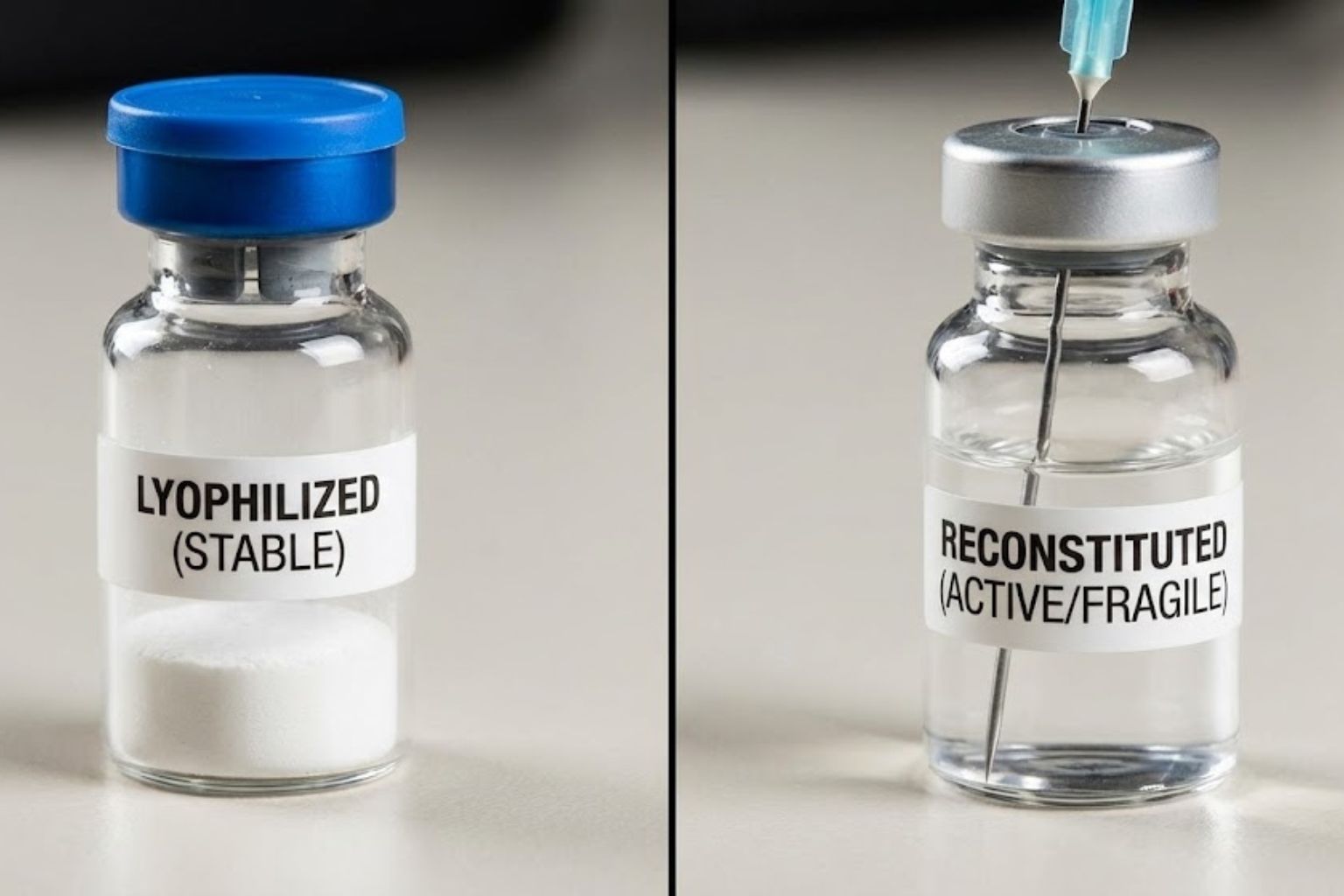
Lyophilized (The “Sleeping” State): Manufacturers supply Survodutide as a freeze-dried powder (often a white “puck” or cake). In this state, water has been sublimated away. Without water, hydrolysis cannot occur. The peptide is in suspended animation. It is robust, stable, and can withstand minor temperature fluctuations.
-
Reconstituted (The “Awake” State): Once you add water, the peptide becomes mobile. It is now “alive” in the chemical sense. It can move, interact, and degrade. The vulnerability increases by a factor of 1000x. This is why Survodutide storage rules change drastically the moment the needle enters the pen peptide.
4. Temperature Requirements & Refrigeration Protocols
The “Golden Rule” of peptide chemistry is: colder is generally better, provided it is stable. But “cold” has nuance.
Refrigeration (2–8°C): The Active Zone
For active research where pen peptides are accessed frequently (e.g., daily dosing of mice), Survodutide storage in a standard laboratory refrigerator is the standard.
-
Dedicated Use: Ideally, use a dedicated reagent fridge. Why? Because domestic fridges used for lunch or general storage are opened frequently. Every time the door opens, warm air rushes in, spiking the temperature.
-
The “Frost-Free” Trap: Many modern fridges have “frost-free” cycles. They periodically warm up the coils to melt ice. This invisible thermal cycling is terrible for sensitive peptides. Ensure your lab fridge is a manual defrost or cycle-stable unit.
-
Placement Strategy:
-
Good: Middle shelf, center. This is the most temperature-stable zone.
-
Bad: The Door. The door is the warmest part of the fridge and fluctuates wildly.
-
Bad: The Back Wall. Vials touching the cooling plate can accidentally freeze solid, causing freeze-thaw damage.
-
Freezer Strategy (-20°C to -80°C): The Archive Zone
For long-term banking of lyophilized Survodutide:
-
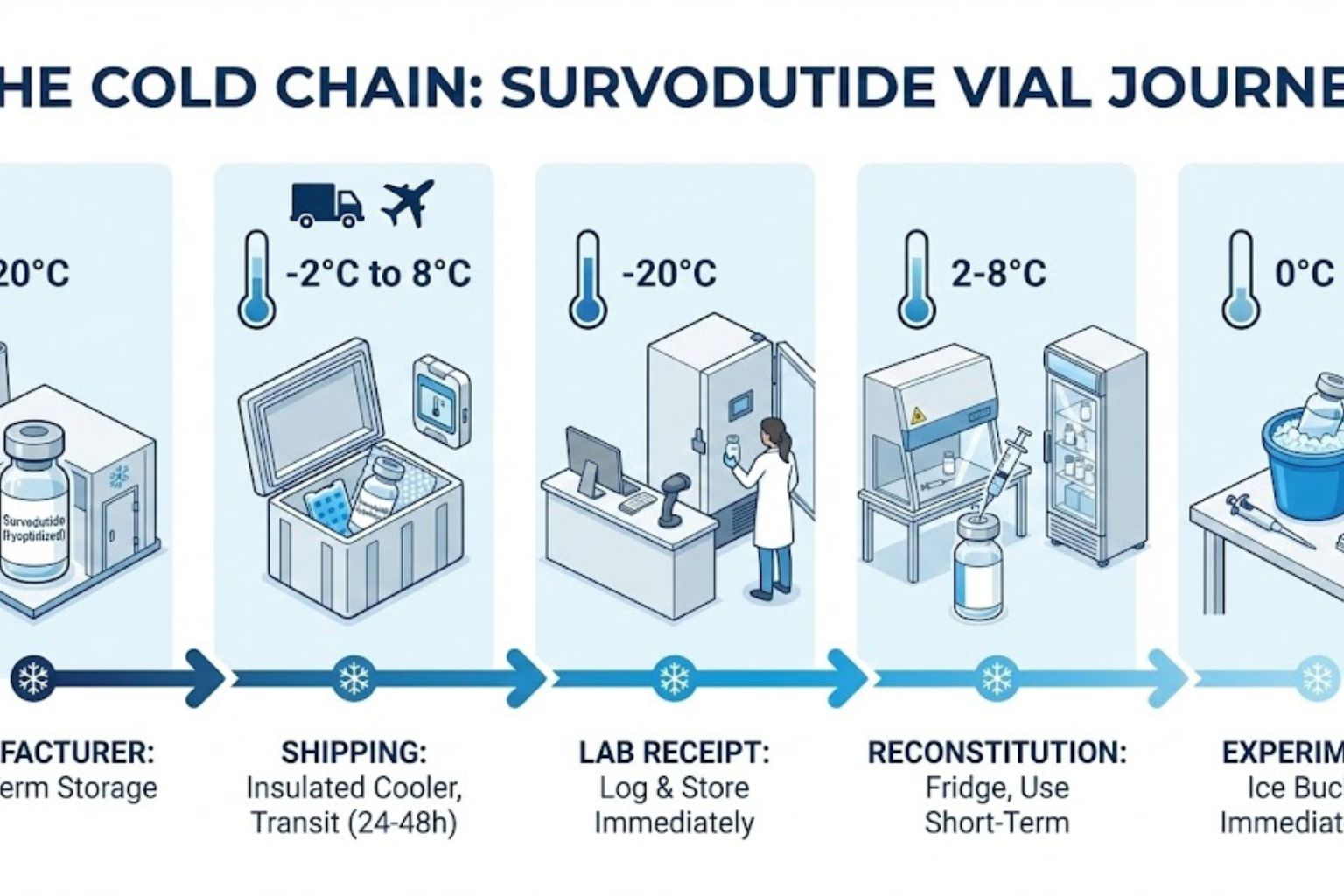
-20°C (Standard Freezer): This is sufficient for storage up to 24 months. Most commercial peptide labs keep their stock here.
-
-80°C (Deep Freeze): Used for indefinite archival storage. If you buy a massive bulk batch to last 5 years, put it here.
-
Warning: Just like with fridges, avoid “auto-defrost” freezers. The heating cycles designed to melt ice can “cook” the outer layers of the peptide powder over months.
Room Temperature Tolerance
Researchers often panic if a shipment arrives slightly warm.
-
Lyophilized: Survodutide powder is surprisingly heat tolerant. It can usually survive room temperature (20–25°C) for several days (e.g., during shipping delays) without significant loss of purity, provided it is kept dry and dark.
-
Reconstituted: This is not shelf-stable. If a liquid pen peptide is left on the bench overnight at 20°C, roughly 1-5% degradation may occur. While it might still work for a rough range-finding test, it should be discarded for critical quantitative assays.
5. Reconstituted Survodutide Storage Requirements
Once bacteriostatic water or sterile saline is added, the Survodutide storage game changes. You are now fighting entropy on a fast timeline.
Mandatory Refrigeration
Reconstituted Survodutide must always be kept at 2–8°C. There is no exception. At room temperature, the peptide will degrade via deamidation and hydrolysis within hours/days.
The 14-Day Rule
-
Theoretical vs. Practical: Some data suggests peptides can remain stable for 30+ days in bacteriostatic water.
-
The Peptide Pro Recommendation: We advise a strict 14-day use window. Why? Because every day introduces risk. Oxidation slowly accumulates. Bacterial contaminants (if introduced) slowly multiply. For the cost of a pen peptide versus the cost of a failed experiment, fresh is always better.
Microbial Risk & Bacteriostatic Water
-
Sterile Water: If you use pure sterile water, you have zero antimicrobial protection. Any bacteria introduced by the needle will grow. You must use the pen peptide immediately (within 24 hours).
-
Bacteriostatic Water: This contains 0.9% Benzyl Alcohol. This preservative inhibits bacterial growth, allowing you to store the pen peptide for the full 14-day window safely. Crucial: Ensure your test subjects (e.g., specific cell lines) are not sensitive to benzyl alcohol.
The Aliquoting Strategy (The Pro Protocol)
If you reconstitute a 10mg pen peptide but your daily research dose is only 100mcg, do not store the main pen peptide in the fridge and puncture it 100 times. Every puncture introduces air and potential contaminants.
The Correct Protocol:
-
Reconstitute the full 10mg pen peptide.
-
Prepare 20 sterile microcentrifuge tubes or insulin syringes.
-
Immediately draw the solution into these separate aliquots.
-
Freeze these aliquots at -20°C (only if your protocol verifies Survodutide survives freezing in liquid—otherwise, refrigerate).
-
Each day, take one aliquot, use it, and discard the rest. This ensures the main stock is never contaminated or thermally stressed.
6. Protecting Survodutide From Degradation
Survodutide storage is not just about temperature; it is about shielding the molecule from environmental enemies.
Photodegradation (The Light Threat)
Peptides are sensitive to UV radiation. Light energy can excite electrons in the tryptophan or tyrosine residues, causing the molecule to cleave or cross-link.
-
The Fix: Always store pen peptides in amber glass (if provided) or keep clear pen peptides inside their original cardboard boxes.
-
Lab Hygiene: Don’t leave pen peptides sitting on a windowsill or under the harsh UV lamp of a biosafety cabinet for longer than necessary.
Freeze-Thaw Damage (The Physical Threat)
This is the most common way researchers ruin good peptides.
-
The Physics: When water freezes, it expands. It forms sharp crystalline lattices. These crystals act like microscopic knives on the peptide structure.
-
The Gradient: Freezing also concentrates salts and buffers in the remaining liquid phase, creating pH spikes that can denature the protein.
-
Rule: Never refreeze a pen peptide that was thawed. If you take it out of the freezer, it stays out. This is why aliquoting is so critical.
Agitation (The Shear Threat)
-
The Mistake: A researcher adds water to the powder and then shakes the pen peptide vigorously like a maraca to dissolve it.
-
The Consequence: This introduces shear stress. It creates foam. Proteins denature at the air-water interface of bubbles (foaming).
-
The Fix: “Swirl, don’t shake.” Gently rotate the pen peptide. Let it sit for 2-3 minutes. The peptide will dissolve naturally.
7. How to Store Survodutide During Travel & Transport
Research often requires moving samples—shipping to a collaborator, moving labs, or carrying samples to a specialized imaging facility.
The Cooler Setup
-
Container: Use a hard-shell insulated cooler or a thick-walled Styrofoam box.
-
Coolant: Use frozen gel packs. Avoid loose ice (it melts and leaks).
The Sandwich Configuration
-
Step 1: Place frozen gel packs at the bottom.
-
Step 2 (CRITICAL): Place a “thermal buffer” layer. This can be bubble wrap, a towel, or a cardboard divider.
-
Step 3: Place the Survodutide pen peptides on top of the buffer.
-
Step 4: Add another buffer layer and more gel packs on top.
-
Why? If the liquid pen peptide touches the frozen gel pack directly, it will “shock freeze” or reach temperatures below 0°C. For liquid peptides, this unintentional freezing is damaging.
Air Travel
-
Carry-On Only: Never check peptides into the hold. The cargo hold can experience extreme temperatures (freezing) and pressure drops that can pop the rubber stoppers.
-
Security: Bring a “Research Use Only” declaration letter and the MSDS (Material Safety Data Sheet). Explain to security that these are biological samples that cannot be X-rayed (though X-rays are generally safe, hand inspection is preferred to avoid questions).
Vehicle Transport
-
The Hot Car: In summer, a parked car can reach 60°C. This will cook your Survodutide in minutes.
-
Protocol: The cooler goes where you go. Never leave it in the car. If driving, keep the AC on and place the cooler in the passenger footwell (coolest spot), not the trunk.
8. Survodutide Expiry, Shelf Life & Quality Assessment
How do you know if your Survodutide storage has failed?
Expiry Timelines
-
Lyophilized: Usually 24 months from the date of manufacture if kept at -20°C.
-
Reconstituted: 14–30 days at 2–8°C.
-
Room Temp (Lyophilized): ~1-2 weeks (emergency buffer).
-
Room Temp (Liquid): < 24 hours.
Visual Inspection Checklist
Before every single injection or assay, hold the pen peptide up to a light source.
-
Clarity: The solution should be crystal clear, like water.
-
Cloudiness: If it looks milky or hazy, the peptide has aggregated or bacteria are growing. Discard immediately.
-
Particulates: If you see “strings” or white flakes floating, the peptide has precipitated. It will not work.
-
Color: If it has turned yellow or brown, it has oxidized. Discard.
9. Establishing Laboratory Storage Protocols
To maintain professional standards at peptidepro.co.uk, labs should implement Standard Operating Procedures (SOPs). Reliance on memory is reliance on failure.
The Receipt Protocol
-
Log It: Upon arrival, log the Lot Number, Batch Number, and Expiry Date in a central registry.
-
Inspect It: Check the ice packs. Were they still cold? If warm, quarantine the batch and contact the supplier.
The Labeling Protocol
-
Date It: The moment you add water, write the Date of Reconstitution on the pen peptide label with a Sharpie.
-
Calc It: Write the concentration (e.g., “2mg/ml”) on the label.
-
Flag It: If the pen peptide is nearing its 14-day limit, mark it with red tape.
The Inventory Strategy (FIFO)
Use the FIFO (First In, First Out) method. Store new boxes behind old boxes. This prevents you from finding a 3-year-old expired box at the back of the freezer while you used the fresh batch yesterday.
The Emergency Excursion Plan
What if the power goes out?
-
Short Term: Keep the fridge door closed. A good fridge holds temp for 4-6 hours.
-
Long Term: Have a backup cooler and ice packs ready. Move the samples to the cooler or a backup generator-powered fridge.
10. Common Storage Mistakes & How to Avoid Them
Even experienced researchers make mistakes with Survodutide storage.
-
Mistake: Storing reconstituted peptides in the freezer to “make them last longer.”
-
Reality: Unless you have a specific flash-freezing protocol with cryoprotectants, standard freezing damages the solution via crystal formation. Fix: Only freeze lyophilized powder.
-
-
Mistake: Reconstituting with unbuffered water.
-
Reality: The pH of pure water can swing acidic, damaging the peptide. Fix: Use bacteriostatic water or a buffered saline.
-
-
Mistake: Ignoring the “pop.”
-
Reality: Lyophilized pen peptides are sealed under vacuum. When you insert the needle, it should suck the water in (“pop”). Fix: If there is no vacuum, the seal was compromised. The peptide may be oxidized. Proceed with extreme caution.
-
-
Mistake: “Top Shelf” Storage.
-
Reality: Storing pen peptides near the cooling vent at the top of the fridge can freeze them. Fix: Middle shelf only.
-
11. Survodutide Storage FAQs
Q: Can I store Survodutide in a standard kitchen fridge? A: Yes, if you are a researcher working from a home setup or small clinic. However, keep it in a sealed, airtight Tupperware container. This protects it from food contaminants (odors, spills) and buffers it against the temperature swings of the door opening. Keep it away from the veggie drawer (humidity).
Q: What if I left it out on the bench overnight? A: Lyophilized: It is likely fine. Put it back in the freezer. Reconstituted: It has likely lost some potency. If you are doing a critical dose-response curve, throw it out. If you are just doing a mechanical test, it might be passable, but note the excursion.
Q: Why is my solution cloudy? A: Cloudiness = Death. It means the peptide has come out of solution (aggregated) or bacteria have taken over. Do not inject. Do not use.
Q: Can I pre-load syringes and store them? A: Yes, this is a common “meal prep” strategy for researchers. Pre-load insulin syringes, cap them, and store them in the fridge. This reduces the daily handling of the main pen peptide. However, ensure the syringe caps are tight to prevent evaporation.
12.Maximizing Research Value
Proper Survodutide storage is the bedrock of successful metabolic research. You cannot build valid scientific conclusions on a foundation of degrading reagents.
By adhering to strict cold-chain protocols, minimizing light exposure, avoiding the physical violence of shaking and freeze-thawing, and respecting the fragility of the reconstituted peptide, researchers can ensure that every microgram of Survodutide delivers precise, reproducible interaction with GLP-1 and Glucagon receptors.
Treat your storage protocol with the same seriousness as your statistical analysis. Good storage means good data.
13. Next Steps for Research Professionals
-
Audit Your Fridge: Go check your reagent fridge right now. Is there a thermometer? Is it calibrated?
-
Stock Up: Ensure you have enough bacteriostatic water and amber pen peptides for your next reconstitution.
-
Download SOPs: Create a one-page “Peptide Handling Guide” based on this blog and tape it to your lab fridge for all students/staff to see.
14. References
-
Manning, M. C., et al. (1989). Stability of protein pharmaceuticals.
-
Pharmacopoeia standards for peptide handling (USP <1044>).
-
Bruck, R., et al. (2023). Structure-function relationships of dual GLP-1/glucagon receptor agonists.