

Troubleshooting Thymulin Storage Failures
The Silent Experiment Killer
In the exacting world of peptide research, there is no greater frustration than the “silent failure.” You prepare your samples, treat your cell cultures, and run your assays, only to find… nothing. No T-cell differentiation, no immunomodulatory effect, just flat-line data. Was the hypothesis wrong? Was the assay flawed? Or, as is often the case, was the reagent compromised?
For researchers in the UK working with Thymulin (Facteur Thymique Sérique), this risk is elevated. Thymulin is not a rock-stable compound; it is a delicate nonapeptide that requires a specific Zinc ion (Zn2+) to maintain its biological activity. Thymulin degradation is often invisible to the naked eye, leading researchers to blame their experimental design when they should be blaming their storage protocols.
Troubleshooting Thymulin degradation requires a detective’s mindset. You must look beyond the obvious. While a cloudy pen peptide is a clear scream for help, a crystal-clear pen peptide can still harbor a broken zinc complex or oxidized residues. This guide is dedicated to the art of troubleshooting—helping you identify, understand, and prevent the signs of degradation that threaten the validity of your research.
The Anatomy of Thymulin Degradation
To spot the enemy, you must understand it. Thymulin degradation isn’t a single event; it is a collection of chemical and physical pathways that destroy the molecule’s utility.
Mechanism 1: Zinc Dissociation (The Invisible Threat)
Thymulin is unique because its active form is a metallopeptide (FTS-Zn). The peptide chain wraps around a zinc ion.
-
The Failure: If the pH of your solution drops (becomes acidic) or if a chelating agent (like EDTA) is introduced, the zinc ion detaches.
-
The Result: You are left with FTS (the peptide alone), which is biologically inactive. The solution looks perfect, but the “engine” is gone.
Mechanism 2: Hydrolysis
This is the breaking of the peptide bonds between amino acids.
-
The Cause: Water is the enemy here. Over time, especially if the temperature rises, water molecules attack the peptide bonds, chopping the nonapeptide into smaller, useless fragments.
Mechanism 3: Oxidation
Specific amino acids in Thymulin are prone to reacting with oxygen.
-
The Cause: Exposure to air (headspace in the pen peptide) or light (photodegradation).
-
The Result: The chemical structure changes, preventing the peptide from fitting into its receptor target.
Visual Troubleshooting: What Your Eyes Can Tell You
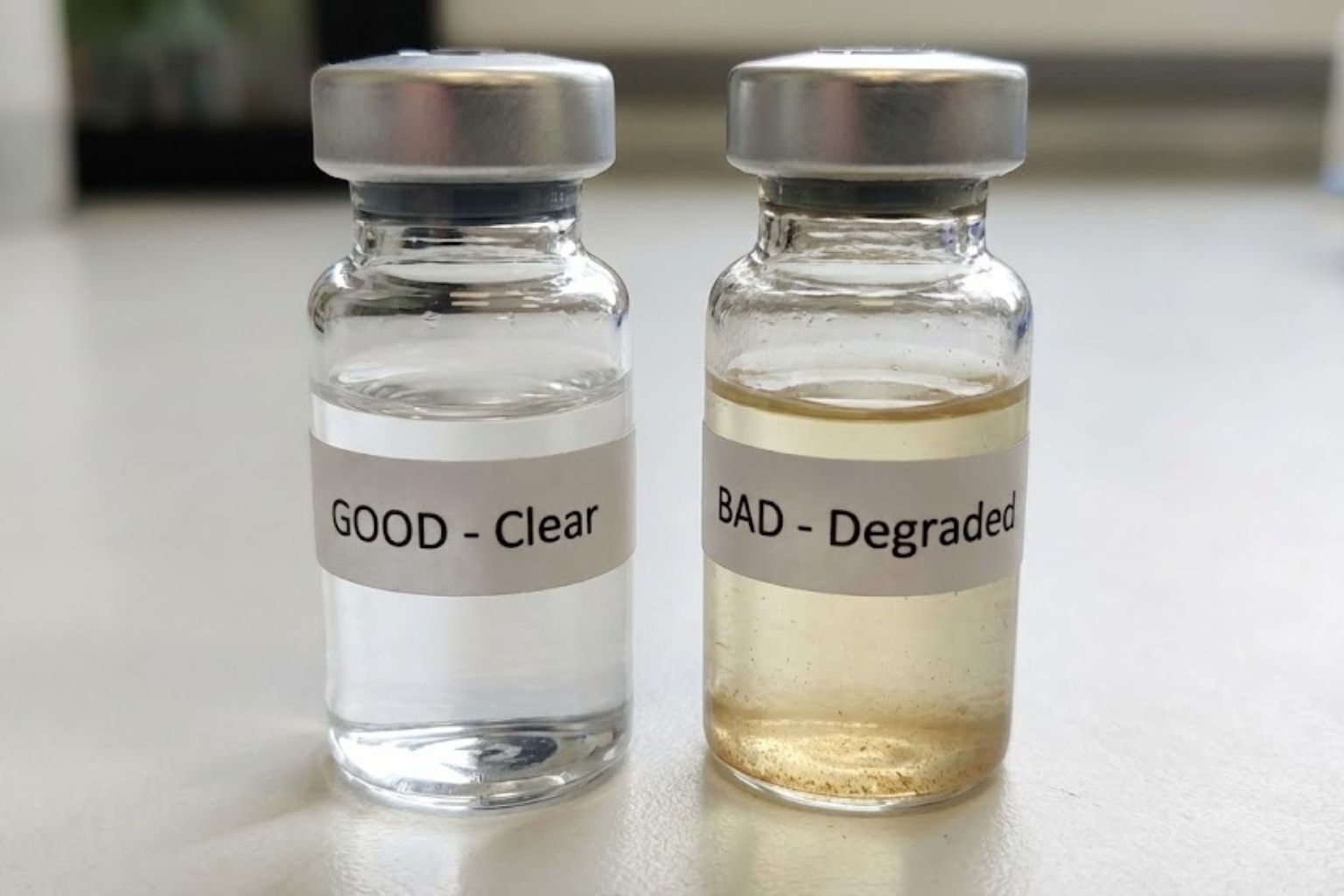
While some forms of Thymulin degradation are invisible, many manifest physically. Before every experiment, perform a 10-second visual inspection.
Turbidity (Cloudiness)
A healthy reconstituted Thymulin solution should be as clear as pure water.
-
The Sign: Hold the pen peptide up to a light source. If you see a faint haze, milkiness, or “fog” inside the liquid, this is a major red flag.
-
The Diagnosis: This usually indicates protein aggregation. The peptide molecules have unfolded and clumped together. These clumps are biologically inactive and can trigger immunogenic responses in in vivo models, ruining the data.
Particulates and Precipitation
Sometimes, the peptide falls out of solution entirely.
-
The Sign: Look at the bottom of the pen peptide. Do you see small white specks, flakes, or a thin layer of dust?
-
The Diagnosis: This is severe Thymulin degradation. It suggests the concentration was too high, the solvent was incompatible, or the peptide has undergone catastrophic aggregation. Do not use this pen peptide. Filtering it will not save it; it will only remove the peptide you need.
Color Changes
Thymulin powder and solution should be white/colorless.
-
The Sign: A yellow or brownish tint.
-
The Diagnosis: This is the hallmark of oxidation. Just as a cut apple turns brown, oxidized peptides discolor. This is irreversible.
Chemical Troubleshooting: The Zinc Connection
As mentioned, Thymulin degradation often involves the loss of Zinc. Since you cannot “see” a missing ion, you must troubleshoot your buffer and environment.
The pH Audit
If your results are inconsistent, check the pH of your reconstitution solvent.
-
Ideal Range: pH 7.0 to 7.4 (Neutral).
-
The Danger Zone: Anything below pH 6.0 promotes Zinc dissociation.
-
Common Mistake: Using unbuffered water that has absorbed CO2 from the air, becoming slightly acidic (carbonic acid). Solution: Always use a buffered solvent (like PBS) or check the pH of your water before mixing.
The Chelator Check
Did you use a generic laboratory buffer?
-
The Issue: Many standard lab buffers contain EDTA (Ethylenediaminetetraacetic acid) to stop enzymatic activity. EDTA is a metal scavenger. It will steal the Zinc ion from Thymulin instantly.
-
Troubleshooting: Review the ingredients of every solvent that touches your Thymulin. If EDTA or Citrate is present, Thymulin degradation (inactivation) is guaranteed.
Root Cause Analysis: Why Did It Fail?
When you confirm Thymulin degradation, you must find the source to prevent recurrence. Use this checklist to identify the culprit.
Suspect A: The Freeze-Thaw Cycle
This is the most common cause of aggregation/turbidity.
-
Investigation: specific questions to ask: Was this pen peptide frozen, thawed, used, and put back in the freezer?
-
The Mechanism: Freezing creates ice crystals that act like microscopic blades. Repeated cycling shreds the peptide structure.
-
The Fix: Switch strictly to single-use aliquots.
Suspect B: The “Frost-Free” Freezer
-
Investigation: Check the make and model of your freezer. Does it have an “Auto-Defrost” feature?
-
The Mechanism: These freezers warm up periodically to melt ice on the coils. This thermal cycling is disastrous for peptides.
-
The Fix: Move all peptides to a manual-defrost unit immediately.
Suspect C: Bacterial Contamination
-
Investigation: Did the turbidity appear after the pen peptide had been open for a few days?
-
The Mechanism: Bacteria and fungi love peptides; they eat them. As bacteria grow, they cloud the water. They also release proteases (enzymes) that actively digest the Thymulin.
-
The Fix: Use bacteriostatic water (with benzyl alcohol) and improve aseptic technique (alcohol wipes, sterile hood).
Analytical Verification (Advanced Troubleshooting)
For high-stakes research, relying on visual checks isn’t enough. If you suspect Thymulin degradation is affecting a critical study, you need hard data.
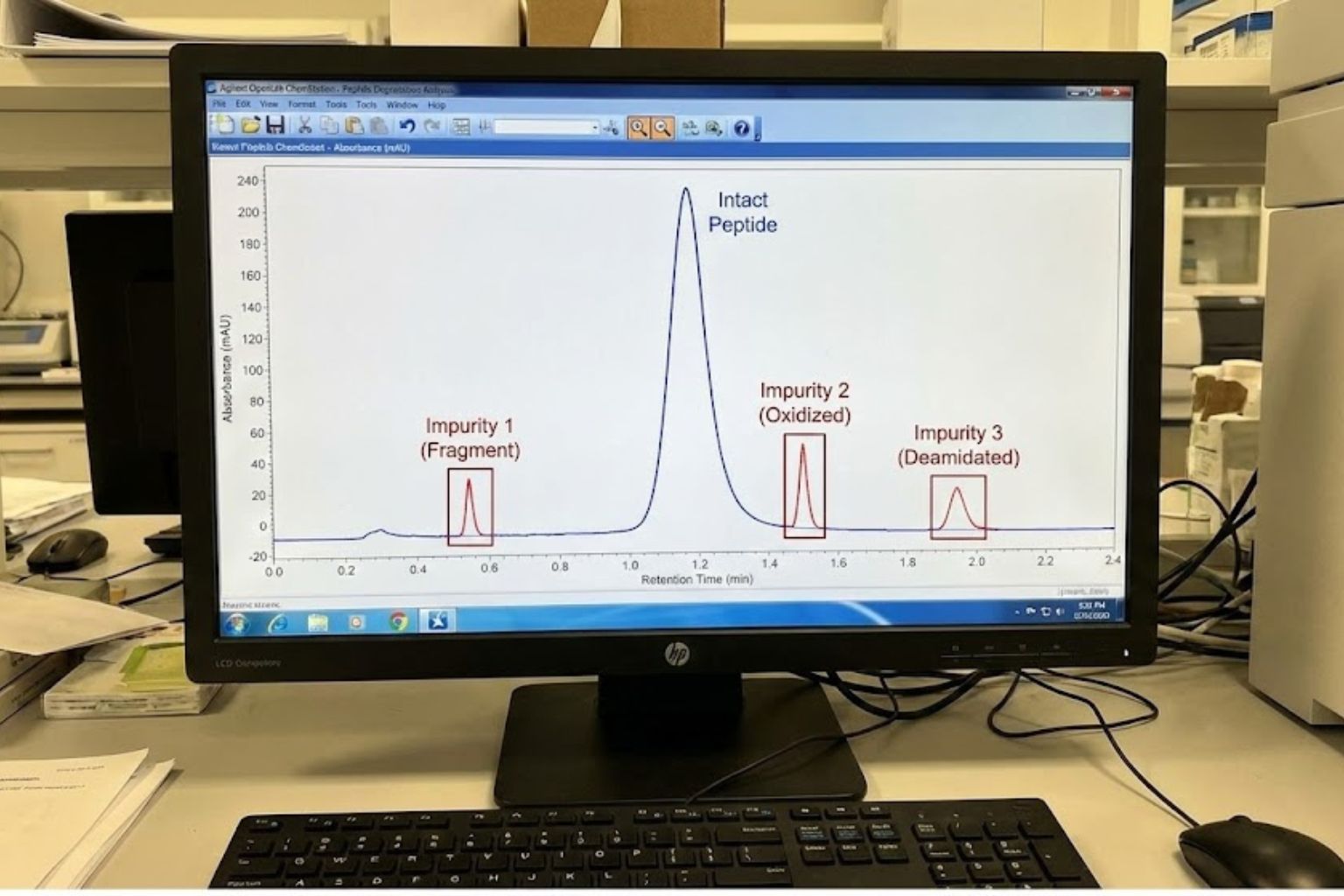
HPLC (High-Performance Liquid Chromatography)
This is the gold standard for purity testing.
-
What to look for: A pure sample will show a single, sharp peak at a specific retention time.
-
Degraded Sample: You will see the main peak shrink, and new “shoulder” peaks or smaller peaks appear. These represent fragments or oxidized variants.
Mass Spectrometry (MS)
If you need to know how it broke.
-
What it tells you: MS measures the molecular weight.
-
The Clue: If you see a mass shift of +16 Da (Daltons), that indicates an Oxygen atom has been added (Oxidation). If you see smaller masses, it indicates Hydrolysis (the chain has been cut).
Impact on Experimental Data
Why does this matter? Thymulin degradation doesn’t just mean “no results”; it can mean “wrong results.”
The False Negative
You treat T-cells with Thymulin to see if they mature. They don’t. You conclude “Thymulin does not affect these cells.”
-
Reality: Thymulin does affect them, but your specific pen peptide was inactive FTS (missing Zinc). You have just published a false conclusion because of a storage error.
The “Noisy” Data
-
Scenario: Your error bars are huge. Some replicates worked, others didn’t.
-
Cause: You used a pen peptide that was slowly degrading over the course of the week. The cells treated on Monday got a potent dose; the cells treated on Friday got a half-dose. Thymulin degradation introduces uncontrolled variables.
Rescue vs. Discard: A Decision Matrix
You found a pen peptide that was left on the bench overnight. Do you save it or bin it? Here is a decision framework for Thymulin degradation.
| Scenario | Condition | Decision |
| Lyophilised Powder | Left at Room Temp (24 hrs) | KEEP. Powder is stable. |
| Reconstituted Liquid | Left at Room Temp (>4 hrs) | DISCARD. Hydrolysis risk is high. |
| Visuals | Cloudy / Hazy | DISCARD. Aggregation is irreversible. |
| Visuals | Particulates visible | DISCARD. Severe degradation. |
| History | Freeze-Thawed 3+ times | DISCARD. Structural integrity compromised. |
| Zinc Status | Reconstituted in EDTA buffer | DISCARD. Zinc is stripped. |
The Golden Rule: When in doubt, throw it out. The cost of a new pen peptide is tiny compared to the cost of repeating a month-long experiment.
Preventive Maintenance: Stopping Degradation Before It Starts
Troubleshooting is reactive; prevention is proactive. To banish Thymulin degradation from your lab:
-
Aliquot Immediately: Never give yourself the chance to freeze-thaw a master pen peptide.
-
Amber Vials: Block the light. If you don’t have amber tubes, wrap clear ones in foil.
-
Headspace Management: If you are storing a liquid for a long time, try to minimize the air gap in the tube (fill the tube) to reduce oxidation potential.
-
Date Everything: A pen peptide without a date is a ticking time bomb. You will forget how old it is.
Frequently Asked Questions (Troubleshooting Edition)
Q: Can I re-filter a cloudy solution to “clean” it?
A: No. The cloudiness is the peptide. If you filter it, the filter will trap the aggregated peptide clumps, and the liquid coming out the other side will be sterile water with almost no Thymulin in it.
Q: My lyophilised powder looks like a “puck” that has shrunk. Is this degradation?
A: Not necessarily. This is often just the “cake” collapsing physically. As long as it is still white and dissolves instantly upon adding water, it is likely fine. Thymulin degradation in powder form is usually indicated by discoloration (yellowing) or melting/stickiness (moisture ingress).
Q: I used water with pH 6.5. Is the Zinc gone?
A: It’s a borderline risk. At pH 6.5, the equilibrium shifts, and some Zinc may dissociate. It might still work for robust assays, but for sensitive work, it is compromised. Adjust the pH to 7.2–7.4 immediately, which may allow the Zinc to re-coordinate, but it’s not guaranteed.
Q: Does sonication help dissolve the peptide and fix clumps?
A: Never sonicate Thymulin. Sonication generates heat and massive shear forces that will tear the peptide apart. If it doesn’t dissolve with gentle swirling, it is likely already degraded or you are using the wrong solvent.
Vigilance is Key
Thymulin degradation is the ghost in the machine of immunological research. It is often subtle, frequently overlooked, and always destructive to data integrity. By learning to recognize the visual cues of turbidity and discoloration, and by understanding the invisible chemical threats of Zinc dissociation and oxidation, you empower yourself to trust your reagents.
Do not let a bad storage protocol undermine your scientific potential. Be vigilant. Inspect your pen peptides. Respect the chemistry. And remember: a result of “no effect” is only valid if you are certain your Thymulin was active.
Next Steps for Researchers
-
Review your stocks: Go to your freezer today. Hold every Thymulin pen peptide up to the light. If it’s cloudy, bin it.
-
Check your buffers: Ensure your reconstitution media is free of EDTA and pH balanced.
-
Upgrade your plastics: Order amber microcentrifuge tubes to reduce photodegradation risks for your next batch.
References
-
Gastinel, L. N., et al. (1984). Structural guarantees for the biological activity of the thymus-derived peptide, thymulin.
-
Dardenne, M., & Savino, W. (1994). Control of thymus physiology by peptidic hormones and neuropeptides.
-
Manning, M. C., et al. (1989). Stability of protein pharmaceuticals.