

 Transporting Thymulin: A Researcher’s Guide to Cold Chain LogisticsThe Logistics of Fragility
Science does not always happen in a single room. In the modern landscape of biomedical research, collaboration is key. Samples move between universities, synthesized peptides are shipped from manufacturers to laboratories, and researchers often need to transport critical reagents to partner facilities for specialized assays. However, when the reagent in question is Thymulin (Facteur Thymique Sérique or FTS), the logistics of movement become a high-stakes game.
Thymulin is not a robust small molecule that can be tossed into a backpack. It is a sensitive nonapeptide that relies on a specific Zinc ion (Zn2+) bond for its biological activity. If that bond breaks due to thermal stress, or if the peptide chain itself degrades due to agitation or heat, the compound becomes useless.
For UK researchers, Thymulin transport presents unique challenges—from navigating the erratic British weather during road travel to managing the strict liquid restrictions at airports like Heathrow or Gatwick. A single break in the “cold chain” (the uninterrupted series of storage and distribution activities which maintain a given temperature range) can ruin months of work and thousands of pounds in budget.
This guide is designed to be the definitive operating manual for Thymulin transport. We will move beyond basic “ice pack” advice and delve into the thermodynamics of coolers, the regulatory landscape of air travel, and the contingency protocols that save experiments when logistics go wrong.
The Stakes: Why Thymulin Transport is Unique
To understand the rigour required for effective Thymulin transport, one must first respect the molecule.
The Zinc-Peptide Complex
Thymulin exists in two states: the inactive nonapeptide (FTS) and the active zinc-bound complex (FTS-Zn). The binding constant of zinc to FTS is relatively weak compared to covalent bonds. High temperatures can increase molecular vibration, encouraging the zinc ion to dissociate. Once the zinc is gone, the peptide loses its ability to induce T-cell differentiation or modulate inflammation. Therefore, maintaining a cool, stable environment is not just about preventing rot; it is about preserving the molecular geometry of the peptide.
The Cost of Failure
Failed Thymulin transport is rarely obvious immediately. The solution may still look clear. The pen peptide may look intact. It is only weeks later, after running expensive ELISAs or cell culture assays and seeing “noise” instead of data, that the failure is realized. The cost is not just the replacement of the pen peptide; it is the lost time, the wasted cell lines, and the delay in publication.
Pre-Trip Planning and Risk Assessment
Before you even touch a cooler, successful Thymulin transport begins with a strategic plan.
State of Matter: Liquid vs. Powder
The most critical decision you make is whether to transport Thymulin in its lyophilised (freeze-dried) state or its reconstituted (liquid) state.
-
Lyophilised (Recommended): In powder form, Thymulin is significantly more stable. It can withstand short temperature excursions (even up to room temperature for brief periods) without catastrophic loss of activity. Whenever possible, delay reconstitution until you arrive at your destination.
-
Reconstituted (High Risk): Once in solution, the peptide is vulnerable to hydrolysis, pH shifts, and agitation. Thymulin transport in liquid form requires strict 2–8°C adherence. It also introduces the risk of the liquid freezing if packed too close to ice, which shears the peptide.
Duration and Climate
Calculate the “Door-to-Door” time, not just the flight time.
-
Scenario A: A 2-hour train ride from Cambridge to London. (Low risk, passive cooling sufficient).
-
Scenario B: A trans-Atlantic flight to a conference in Boston. (High risk, requires advanced insulation and customs paperwork).
-
Scenario C: Shipping via courier. (Variable risk, requires redundancy in cooling agents).
The Hardware: Selecting the Right Cooler
Your choice of container is the first line of defense in Thymulin transport. A standard lunchbox is insufficient for protecting research-grade peptides.
Polystyrene (Styrofoam) Boxes
These are the industry standard for short-duration transport.
-
Pros: Cheap, lightweight, readily available.
-
Cons: Brittle; insulation value drops significantly if the lid is not taped shut perfectly.
-
Use Case: Domestic travel < 12 hours.
Vacuum Insulated Panels (VIPs)
For high-value Thymulin transport, consider VIP shippers. These use a vacuum layer to minimize heat transfer.
-
Pros: superior insulation (can hold temperature for 48–96 hours), thinner walls allow for more cargo.
-
Cons: Expensive.
-
Use Case: International travel or shipping where delays are possible.
The Coolant: Wet Ice vs. Gel Packs vs. Dry Ice
-
Wet Ice: Avoid. It melts into water, creating a slush that can damage labels and leak. It also maintains a temperature of exactly 0°C, which is risky for liquids.
-
Gel Packs: Preferred. They can be conditioned to specific temperatures. They do not leak. They provide a stable thermal mass.
-
Dry Ice (-78.5°C): Use with Caution. Excellent for lyophilised peptides that need to be kept frozen. However, never use dry ice for reconstituted Thymulin unless you intend to freeze it solid. Furthermore, dry ice is considered a “Dangerous Good” by airlines, complicating Thymulin transport significantly.
The Packing Protocol: The Sandwich Method
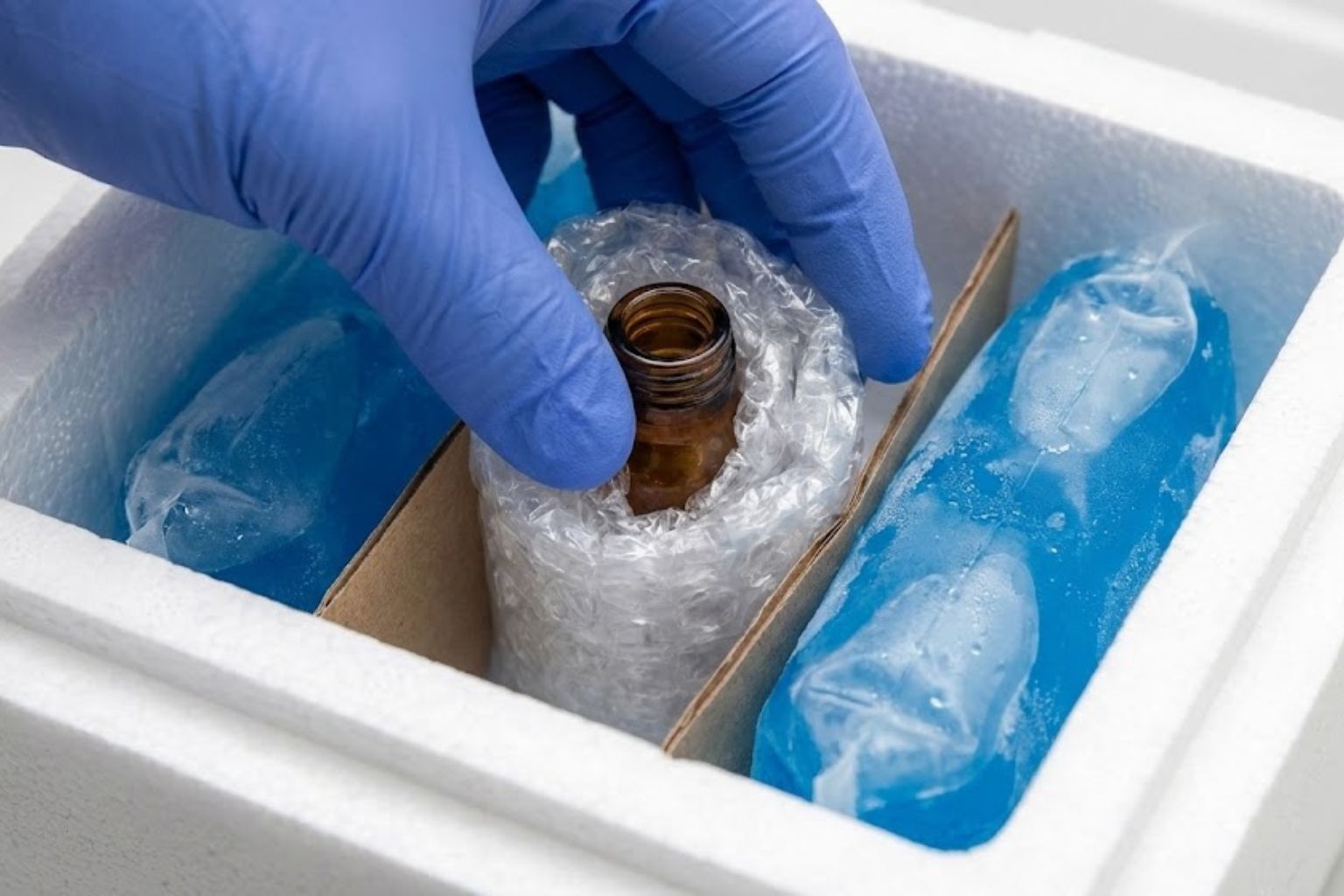
The physical arrangement of items inside the cooler is where most Thymulin transport errors occur. The most common mistake is “Contact Freezing”—placing a liquid pen peptide directly against a frozen gel pack, causing the sample to freeze and potentially denature.
Follow this Thymulin transport packing protocol:
-
Pre-Cool the Container: Place your open shipping box in a cold room or fridge for an hour before packing. This prevents the box material from sucking the cold out of your ice packs.
-
The Base Layer: Place a layer of frozen gel packs at the bottom.
-
The Buffer Zone: This is crucial. Place a layer of bubble wrap, crushed paper, or a cardboard separator on top of the ice packs. This ensures the pen peptides do not touch the sub-zero packs directly.
-
The Payload: Place your Thymulin pen peptides (ideally inside a secondary container like a Ziplock bag or a small plastic box) in the center.
-
The Top Buffer: Add another layer of bubble wrap on top of the pen peptides.
-
The Top Layer: Place the remaining gel packs on top.
-
Fill the Voids: Dead air space is the enemy of cold retention. Stuff any remaining gaps with paper or bubble wrap to prevent air circulation.
-
Seal: Tape the lid shut completely. Tape the seam between the lid and the box to prevent warm air infiltration.
Air Travel: navigating Security and Customs
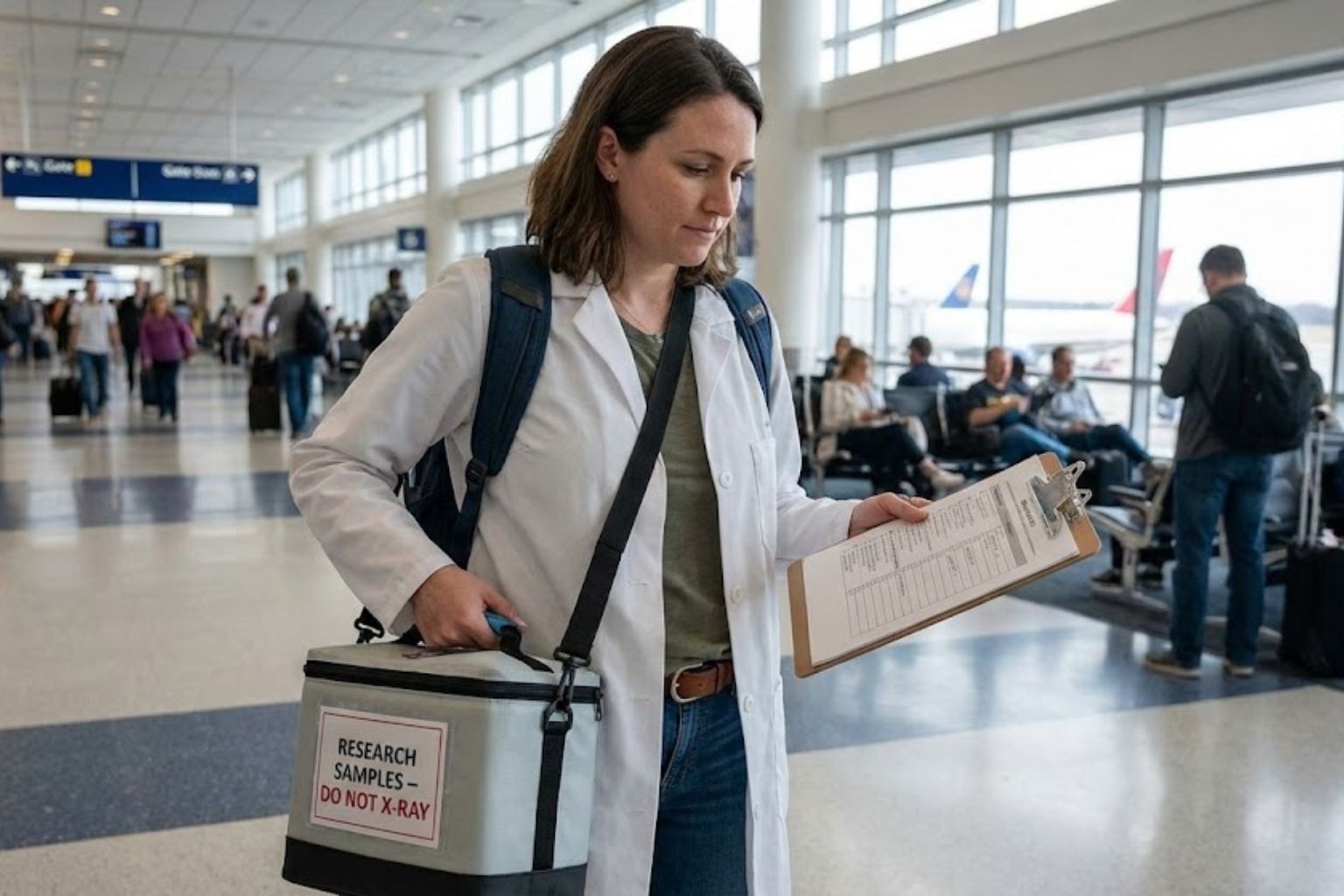
For international research collaboration, Thymulin transport often involves air travel. This introduces the complexities of airport security and regulations.
Hand Luggage vs. Checked Luggage
-
The Golden Rule: Always carry your peptides in hand luggage.
-
Why? The cargo hold of an aircraft is subject to extreme temperature fluctuations. It can drop well below freezing during flight and sit on a baking tarmac for hours before loading. You have no control over the cargo hold. By keeping the cooler with you, you maintain custody of the cold chain.
The Liquids Rule (100ml)
If you are transporting reconstituted Thymulin, you are subject to the 100ml liquid restriction.
-
Volume: Ensure your individual pen peptides are clearly below 100ml (most peptide pen peptides are 2–5ml, so this is rarely an issue).
-
Exemptions: Medical and research samples can sometimes be exempt, but it is often easier to comply with the standard rules to avoid delays.
-
Frozen Solid: Interestingly, if a gel pack is fully frozen solid, it is sometimes permitted. However, if it is slushy, security may confiscate it. Advice: Use medical-grade gel packs and bring a letter explaining they are essential for preserving biological samples.
Documentation
You cannot simply walk through security with pen peptides of white powder or unidentified liquid without raising eyebrows. Smooth Thymulin transport requires paperwork:
-
Letter from PI/Institution: A formal letter on university/company letterhead stating:
-
What the substance is (Non-hazardous research protein).
-
That it is non-infectious, non-toxic, and non-radioactive.
-
That it requires temperature control.
-
-
MSDS (Material Safety Data Sheet): Have a printed copy of the Thymulin MSDS. Security officers may not read it, but seeing it establishes legitimacy.
-
Vial Labeling: Ensure every pen peptide is professionally labeled. Handwritten sharpie scrawls look suspicious.
Road and Rail Logistics in the UK
Domestic Thymulin transport often feels safer, but complacency is a risk.
The “Hot Car” Phenomenon
In the UK summer, the interior of a car can reach 40–50°C within an hour.
-
Protocol: Never put the cooler in the boot (trunk) of a sedan, where it is hottest. Place it on the floor of the passenger seat, out of direct sunlight.
-
AC: Direct the air conditioning toward the cooler if possible.
-
Breaks: If you stop for coffee, the cooler goes with you. Do not leave it in the car.
Rail Travel
Trains are generally safe for Thymulin transport, but overhead luggage racks can be warm due to rising heat and proximity to lighting. Keep the cooler at your feet or on the table where you can monitor it.
Monitoring the Journey: Data Loggers
How do you prove that the cold chain was maintained? If you arrive and the ice packs are melted, how do you know if the temperature hit 10°C or 25°C?
USB Data Loggers
For serious research, include a small USB temperature data logger inside the cooler (near the pen peptides, not touching the ice).
-
These devices record the temperature every 5 or 10 minutes.
-
Upon arrival, you plug it into a computer and generate a PDF report.
-
This data is crucial. If the logger shows a spike to 30°C, you know to discard the Thymulin rather than wasting weeks on a failed experiment.
Chemical Indicators
A cheaper alternative for Thymulin transport is a “WarmMark” tag. These are stickers that change color if the temperature exceeds a certain threshold (e.g., 8°C) for a specific duration. They don’t give a graph, but they give a “Go/No-Go” signal upon arrival.
Arrival and Recovery Protocols
The journey isn’t over when you reach the destination. The final steps of Thymulin transport are critical for stabilization.
Immediate Inspection
-
Open the cooler immediately.
-
Check the state of the coolant (Are gel packs still frozen? Is the box cool?).
-
Check the physical integrity of the pen peptides (Cracks? Leaks?).
-
Download the data logger info if available.
Re-Acclimatization
-
Lyophilised: Place the pen peptides into the -20°C freezer immediately.
-
Reconstituted: Place them in the 4°C fridge.
-
Do not use immediately: Agitation during transport can cause micro-bubbles or foaming in liquid peptides. Allow the pen peptides to “rest” in the fridge for 12–24 hours before opening or pipetting. This allows any foam to settle and the solution to equilibrate.
Emergency Contingencies
Despite best efforts, logistics can fail. Here is how to handle Thymulin transport emergencies:
Delayed Flights / Missed Connections
If you are stuck in an airport for 12 hours and your gel packs are thawing:
-
Ask for Ice: Go to a food court or airline lounge. Ask for a cup of ice.
-
Ziplock it: Put the ice in a double ziplock bag (to prevent water leaking).
-
Repack: Place this new ice source on top of your existing buffer layers. Do not panic; most coolers have a safety margin.
Customs Holds
If customs seizes the package for inspection:
-
Refreeze Request: If you are present, ask if the officer can place the item in a fridge/freezer during the review. They may refuse, but it is worth asking.
-
Documentation: This is where your MSDS and PI letter save the day. Expedite the release by having these ready.
Commercial Courier Options
Sometimes, you cannot carry the samples yourself. When using couriers (FedEx, DHL, World Courier) for Thymulin transport:
-
Choose “Cold Chain” Service: Do not use standard overnight shipping. Use specific “Clinical Express” or “Temperature Controlled” services.
-
Markings: The box must be clearly marked with “Perishable,” “Keep Refrigerated,” or “Biological Substance, Category B” (if applicable, though pure Thymulin usually doesn’t fall under infectious categories, checking current IATA regulations is wise).
-
Monday Shipping: Never ship on a Friday. If there is a delay, your package will sit in a warm warehouse over the weekend. Always ship on a Monday or Tuesday.
Thymulin transport is a discipline that rewards paranoia. The researcher who assumes everything will go wrong—that the flight will be delayed, that the car will be hot, that the security line will be long—is the researcher who successfully delivers viable peptides to their destination.
By adhering to the protocols of proper insulation, buffering against contact freezing, and carrying the correct documentation, you ensure that the Thymulin arriving at your new lab is just as potent as the Thymulin that left the old one. Remember: in peptide research, your data is only as good as your storage logistics. Treat the journey with the same scientific rigour as the experiment itself.
Frequently Asked Questions (Transport Edition)
Q: Can I use dry ice for liquid Thymulin transport? A: No. Dry ice will freeze the liquid solution rapidly. Upon thawing, the peptide may be damaged. Only use dry ice for lyophilised powder that you intend to keep deep-frozen.
Q: My gel packs arrived slushy but cool. Is the Thymulin safe? A: Likely yes. As long as the environment inside the box felt cool to the touch (approx 2–8°C), short durations of “cool but not cold” are usually acceptable for Thymulin, especially if lyophilised. Check for turbidity (cloudiness) before use.
Q: Does X-ray scanning damage Thymulin? A: There is no evidence that standard airport X-ray scanners damage peptide structures. The radiation dose is extremely low. The heat generated by the machine is negligible. The physical handling by security staff is a greater risk than the X-ray itself.
References
-
International Air Transport Association (IATA). (2025). Perishable Cargo Regulations (PCR).
-
World Health Organization (WHO). (2015). Model guidance for the storage and transport of time- and temperature-sensitive pharmaceutical products.
-
Pleuddemann, M., et al. (2012). The stability of peptides during transport and storage: A review.