

What Shall be the Tirzepatide Doses for Weight Loss
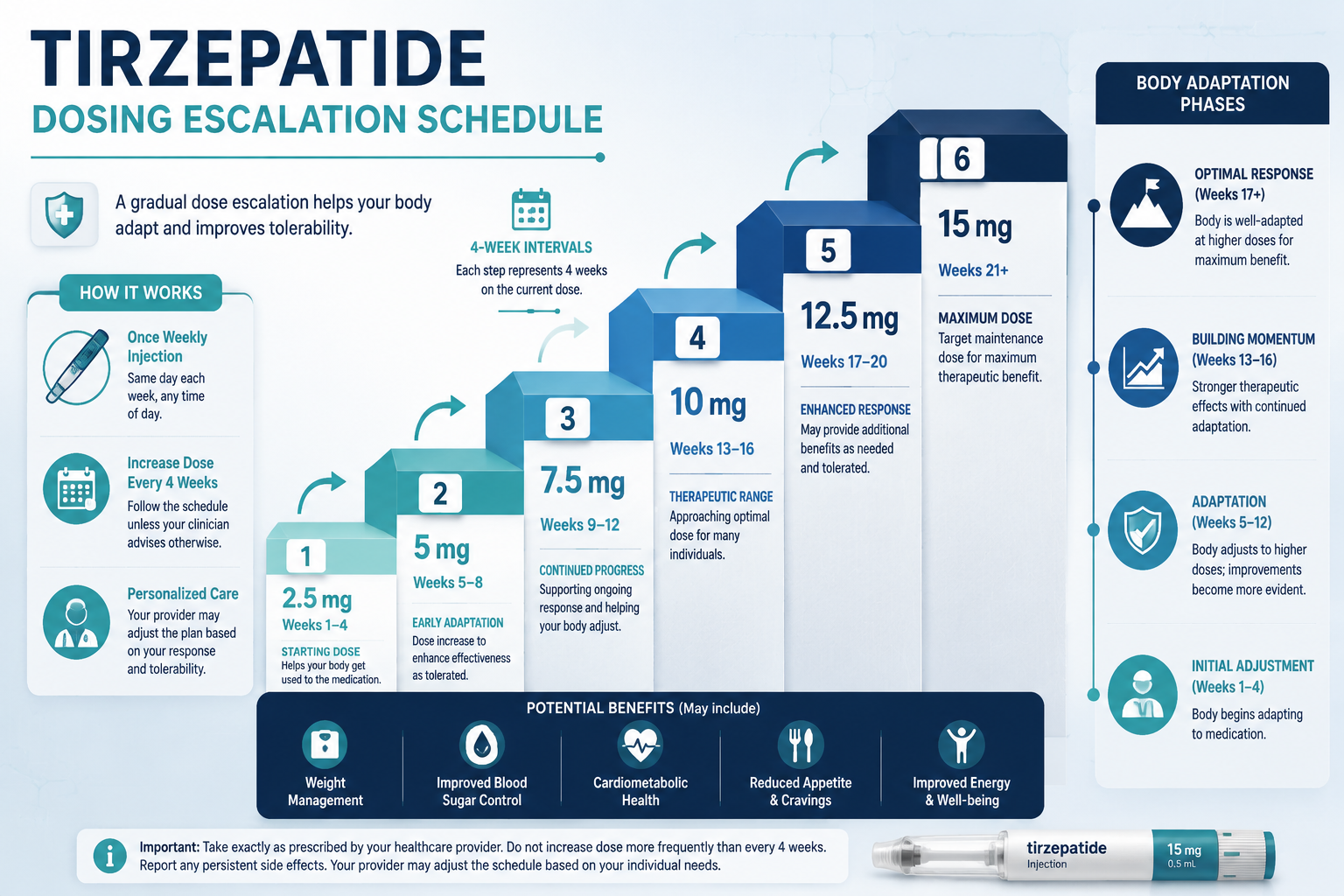
Tirzepatide dosing for body composition management follows a structured escalation protocol starting at 2.5mg weekly and increasing every four weeks through 5mg, 7.5mg, 10mg, 12.5mg, up to a maximum of 15mg weekly. This gradual approach allows your body to adapt to the medication while minimizing side effects and optimizing appetite management results. Most individuals find their effective maintenance dose between 10mg and 15mg, though response varies based on individual metabolic factors and body transformation goals.
Key Takeaways
- Start low, go slow: Tirzepatide dosing begins at 2.5mg weekly and increases gradually every 4 weeks to reduce side effects
- Six dose levels available: 2.5mg, 5mg, 7.5mg, 10mg, 12.5mg, and 15mg provide flexible options for your metabolic health journey
- Maintenance doses vary: Most people achieve optimal appetite management between 10mg-15mg weekly
- Four-week intervals matter: Waiting a full month between dose increases allows proper body adaptation
- Affordable UK access: Tirzeparo provides budget-friendly tirzepatide options from £169-£229 per dose
- Not one-size-fits-all: Your ideal dose depends on individual response, tolerance, and body composition goals
- Medical guidance essential: Dosing decisions should involve healthcare provider consultation
- Combination approach works best: Tirzepatide doses are most effective when paired with exercise and lifestyle changes
What Are the Standard Tirzepatide Doses for Body Composition Management?
Tirzepatide is available in six clinically established doses: 2.5mg, 5mg, 7.5mg, 10mg, 12.5mg, and 15mg, administered as once-weekly subcutaneous injections. Each dose level serves a specific purpose in the escalation protocol designed to optimize metabolic health support while managing potential side effects.
The structured dosing approach works because tirzepatide is a dual GIP and GLP-1 receptor agonist that requires gradual introduction to allow your body’s hormone receptors to adjust. Jumping to higher doses too quickly increases the risk of gastrointestinal side effects like nausea, vomiting, and diarrhea.
The Six Tirzepatide Dose Levels Explained
2.5mg (Starting Dose) – This introductory dose allows your body to begin recognizing and responding to tirzepatide’s appetite-regulating effects. Most people experience minimal side effects at this level while noticing reduced hunger signals. Tirzeparo’s 2.5mg option costs £169, making it an accessible entry point.
5mg (First Escalation) – After four weeks at 2.5mg, the 5mg dose provides increased appetite management without overwhelming your system. This is where many people first notice significant changes in their eating patterns and feeling fuller for longer. Available at £179 through Tirzeparo.
7.5mg (Mid-Range Dose) – This intermediate dose bridges the gap between initial and maintenance levels. Some individuals find 7.5mg to be their optimal long-term dose, particularly those with moderate body composition goals. Tirzeparo offers 7.5mg at £189.
10mg (Standard Maintenance) – Clinical protocols identify 10mg as a common maintenance dose for sustained metabolic health support. This level provides robust appetite management for most users. Tirzeparo’s 10mg dose is priced at £199.
12.5mg (Higher Maintenance) – For those who need additional support beyond 10mg, the 12.5mg dose offers enhanced appetite control. This level is particularly relevant for individuals with higher body composition management needs. Available at £209 from Tirzeparo.
15mg (Maximum Dose) – The highest approved dose provides maximum appetite management effects. Not everyone requires this level, but it’s available for those whose bodies respond optimally at higher doses. Tirzeparo’s 15mg option costs £229.
Dosing Comparison Table
| Dose Level | Purpose | Typical Duration | Tirzeparo Price | Common Experience |
|---|---|---|---|---|
| 2.5mg | Initial introduction | 4 weeks | £169 | Mild appetite reduction, minimal side effects |
| 5mg | First escalation | 4 weeks | £179 | Noticeable hunger management, possible mild nausea |
| 7.5mg | Mid-range option | 4 weeks or maintenance | £189 | Stronger appetite control, body adapting |
| 10mg | Standard maintenance | Ongoing or 4 weeks | £199 | Significant fullness, established routine |
| 12.5mg | Higher maintenance | Ongoing or 4 weeks | £209 | Enhanced appetite management |
| 15mg | Maximum dose | Ongoing maintenance | £229 | Maximum therapeutic effect |
How Should You Escalate Tirzepatide Doses Safely?
Safe tirzepatide dose escalation requires following a four-week interval protocol between increases, allowing your body adequate time to adapt to each new level before progressing. Rushing this timeline significantly increases the risk of side effects and may compromise your body transformation journey.
The standard escalation schedule looks like this: Start at 2.5mg for four weeks, increase to 5mg for four weeks, then 7.5mg for four weeks, followed by 10mg for four weeks. If additional support is needed, continue to 12.5mg for four weeks, and finally 15mg as the maximum dose.
Why Four Weeks Between Dose Increases?
The four-week interval isn’t arbitrary. Tirzepatide’s mechanism involves modulating GIP and GLP-1 receptors throughout your digestive system and brain. These receptors need time to adjust to increased stimulation. Moving too quickly can overwhelm these systems, leading to:
- Severe nausea and vomiting that may require dose reduction
- Gastrointestinal distress including diarrhea and constipation
- Reduced tolerance that makes continuing treatment difficult
- Dehydration risks from excessive vomiting
- Nutritional concerns if you can’t maintain adequate food intake
Step-by-Step Escalation Protocol
Week 1-4: 2.5mg Phase
- Administer your first 2.5mg injection on day one
- Inject the same day each week (set a calendar reminder)
- Monitor how you feel, noting any side effects
- Establish your injection routine and technique
- Track appetite changes and eating patterns
Week 5-8: 5mg Phase
- Increase to 5mg on week five (not before)
- Expect potentially stronger appetite suppression
- Side effects may temporarily increase then stabilize
- Continue monitoring your body’s response
- Adjust meal sizes as appetite naturally decreases
Week 9-12: 7.5mg Phase
- Progress to 7.5mg if you tolerated 5mg well
- Some people choose to remain at 5mg if achieving goals
- Assess whether you need further escalation
- Consider this as a potential maintenance dose
Week 13-16: 10mg Phase
- Move to 10mg for enhanced metabolic support
- Many find this their optimal long-term dose
- Evaluate body composition progress at this level
- Decide if further escalation is necessary
Week 17-20: 12.5mg Phase (if needed)
- Only escalate if 10mg isn’t providing adequate support
- Monitor for increased side effects at higher doses
- Assess benefit versus any discomfort
Week 21+: 15mg Phase (if needed)
- Maximum dose for those requiring highest support level
- Not everyone needs to reach this dose
- Maintain as long-term dose if effective and tolerated
Common Escalation Mistakes to Avoid
Skipping the starting dose: Some people want to begin at 5mg or higher, thinking they’ll see faster results. This dramatically increases side effect risk and often backfires, forcing dose reduction.
Rushing the timeline: Increasing doses every two weeks instead of four doesn’t speed up body transformation—it just increases nausea and other side effects.
Ignoring side effects: If you’re experiencing significant discomfort at your current dose, don’t escalate. Stay at your current level longer or discuss with a healthcare provider.
Inconsistent injection timing: Taking doses at wildly different times each week reduces effectiveness and makes side effects less predictable.
What Factors Determine Your Ideal Tirzepatide Dose?
Your optimal tirzepatide dose depends on multiple individual factors including your starting body composition, metabolic health status, tolerance to the medication, body transformation goals, and how your body responds to appetite management effects. There’s no universal “best dose” because metabolic responses vary significantly between individuals.
Individual Response Variability
Some people achieve excellent appetite management and body composition results at 5mg or 7.5mg, while others require 12.5mg or 15mg for similar effects. This variation stems from differences in:
- Receptor sensitivity: Your GIP and GLP-1 receptors may be more or less sensitive to tirzepatide
- Metabolic rate: Baseline metabolism affects how your body processes the medication
- Body composition: Starting point influences dose requirements
- Hormonal factors: Existing hormone levels impact response
- Genetic factors: Individual genetic variations affect drug metabolism
Body Composition Goals
Your target outcomes influence which dose becomes your maintenance level. Someone aiming for modest body transformation might find 7.5mg sufficient, while someone with more ambitious goals may benefit from 12.5mg or 15mg.
Choose lower maintenance doses (5mg-7.5mg) if:
- You have moderate body composition goals
- You’re experiencing excellent appetite management at lower levels
- You’re sensitive to medications generally
- You’re achieving steady progress without needing escalation
Consider higher maintenance doses (10mg-15mg) if:
- You have more significant body transformation objectives
- Lower doses aren’t providing adequate appetite management
- You’ve tolerated escalation well without major side effects
- Your progress has plateaued at lower doses
Tolerance and Side Effect Profile
Your ability to tolerate tirzepatide significantly impacts your ideal dose. If you experience persistent nausea, vomiting, or gastrointestinal issues at a particular level, that dose may be too high for you regardless of what clinical protocols suggest.
Signs your current dose is appropriate:
- Manageable or no side effects
- Noticeable appetite reduction
- Feeling fuller for longer after meals
- Steady body composition progress
- Sustainable eating patterns
Signs your dose might be too high:
- Severe, persistent nausea lasting beyond the first week
- Inability to eat adequate nutrition
- Frequent vomiting
- Severe gastrointestinal distress
- Dehydration symptoms
Age and Health Status Considerations
Older adults may require more conservative dosing approaches, potentially staying at lower maintenance doses. Existing health conditions, particularly gastrointestinal issues, may also influence optimal dosing.
How Do Tirzepatide Doses Compare to Semaglutide?
Tirzepatide and semaglutide follow different dosing protocols because they work through distinct mechanisms—tirzepatide activates both GIP and GLP-1 receptors while semaglutide targets only GLP-1 receptors. This dual action means tirzepatide often provides more robust appetite management at comparable dose levels.
Semaglutide (Wegovy) escalates from 0.25mg to a maximum of 2.4mg weekly, while tirzepatide ranges from 2.5mg to 15mg weekly. These numbers aren’t directly comparable because the medications have different molecular structures and potencies. A 10mg tirzepatide dose isn’t “stronger” than 2.4mg semaglutide simply based on the numbers—they’re different compounds with different mechanisms.
Key Differences in Dosing Protocols
Escalation speed: Both medications use four-week intervals between increases, but tirzepatide has more dose levels (six versus five for semaglutide), providing finer adjustment options.
Maintenance flexibility: Tirzepatide’s range from 7.5mg to 15mg for maintenance gives more options to find your optimal level compared to semaglutide’s typical 1.7mg or 2.4mg maintenance doses.
Side effect profiles: The dual receptor action of tirzepatide may cause different side effects than semaglutide’s single receptor approach, though both commonly cause nausea and gastrointestinal effects.
For a detailed comparison of these medications, see our comprehensive guide on tirzepatide versus semaglutide.
What Should You Expect at Each Tirzepatide Dose Level?
Understanding what to expect at each dose helps you recognize whether your body is responding appropriately and when it might be time to escalate or maintain your current level.
2.5mg Experience
At the starting dose, expect subtle but noticeable changes. You’ll likely feel slightly less hungry between meals and may find yourself satisfied with smaller portions. Side effects are typically minimal—perhaps mild nausea for a day or two after your first injection, then improvement.
This dose is about establishing your routine and allowing your body to recognize tirzepatide’s presence. Don’t expect dramatic changes yet. You’re laying the foundation for more significant effects at higher doses.
5mg Experience
The 5mg dose is where most people first notice meaningful appetite management. You’ll probably find yourself naturally eating less without feeling deprived. The sensation of fullness arrives sooner during meals and lasts longer afterward.
Side effects may temporarily increase when you first move to 5mg—nausea is common for the first few days after escalation, then typically subsides. Some people experience mild constipation or occasional diarrhea as their digestive system adjusts.
7.5mg-10mg Experience
These mid-to-high doses provide substantial appetite control. Many people report forgetting about food for hours, needing reminders to eat, and feeling satisfied with significantly smaller meals than before starting tirzepatide.
At these levels, you’re likely seeing consistent body composition changes. Your eating patterns have probably shifted considerably—snacking may have virtually disappeared, and you might find previously tempting foods less appealing.
Side effects have usually stabilized by this point if you’ve escalated gradually. Your body has adapted to the medication’s presence, though you may still experience occasional mild nausea, especially if you eat too much or consume very fatty foods.
12.5mg-15mg Experience
The highest doses provide maximum appetite management effects. At these levels, you’ll need to be mindful about eating enough to maintain proper nutrition. The appetite suppression can be so strong that you might need to schedule meals rather than relying on hunger cues.
These doses are for people who need maximum metabolic support and have tolerated the escalation process well. Not everyone requires these levels—many achieve excellent results at 10mg or lower.
How Long Should You Stay on Each Tirzepatide Dose?
The standard protocol calls for four weeks at each dose level during escalation, but your maintenance dose continues indefinitely as long as it remains effective and well-tolerated. Tirzepatide is designed for long-term use, not as a short-term intervention.
Escalation Phase Duration
During the escalation phase (moving from 2.5mg up to your target maintenance dose), stick to the four-week intervals. This timeline is based on clinical protocols designed to optimize safety and effectiveness.
Can you stay longer at a dose? Yes. If you’re experiencing significant side effects at your current dose, it’s perfectly appropriate to remain at that level for six or eight weeks instead of four before escalating. There’s no requirement to rush to higher doses.
Can you escalate faster? This isn’t recommended. While you might tolerate a three-week interval occasionally, consistently shortening the escalation timeline increases side effect risks without meaningful benefits.
Maintenance Phase Duration
Once you reach your optimal maintenance dose, you continue at that level for as long as you’re pursuing body composition management goals. Many people remain on their maintenance dose for months or years.
How long is too long? Current evidence doesn’t suggest a maximum duration for tirzepatide use. It’s designed as a long-term metabolic health support medication, similar to medications for other chronic conditions.
When should you consider stopping? This decision should involve healthcare provider consultation and depends on whether you’ve achieved and stabilized your body composition goals, whether the medication remains effective, and your overall health status.
Dose Adjustments During Maintenance
Your maintenance dose isn’t necessarily permanent. You might need to adjust based on:
- Plateau effects: If body composition progress stalls, you might escalate to the next dose level
- Side effect development: If you develop intolerable side effects, you might reduce to the previous dose
- Goal achievement: Once you’ve reached your target, some people reduce to a lower maintenance dose
- Life circumstances: Stress, illness, or other factors might temporarily affect your optimal dose

What Are the Risks of Incorrect Tirzepatide Dosing?
Incorrect dosing—whether too high, too low, or escalated too quickly—can compromise your body transformation journey and potentially cause health concerns. Understanding these risks helps you appreciate why following proper protocols matters.
Risks of Doses That Are Too High
Taking tirzepatide doses higher than your body can tolerate leads to several problems:
Severe gastrointestinal side effects: Persistent nausea, frequent vomiting, and severe diarrhea can make daily life miserable and may require medical intervention.
Nutritional deficiencies: If side effects prevent adequate food intake, you risk protein deficiency, vitamin deficiencies, and inadequate calorie consumption that can affect muscle mass and overall health.
Dehydration: Vomiting and diarrhea can cause significant fluid loss, leading to dehydration that may require medical treatment.
Treatment discontinuation: Severe side effects often force people to stop tirzepatide entirely, ending their body transformation journey prematurely.
Gallbladder issues: Rapid body composition changes from overly aggressive dosing may increase gallstone risk.
Risks of Doses That Are Too Low
Staying at doses lower than what your body needs to achieve meaningful appetite management also creates problems:
Inadequate appetite management: If your dose is too low, you won’t experience sufficient fullness signals to support your body composition goals.
Frustration and discontinuation: People who don’t see results because their dose is too low often become discouraged and stop treatment.
Wasted time and money: Spending months at an ineffective dose delays progress without benefit.
Risks of Escalating Too Quickly
Rushing through dose escalation creates the worst of both worlds:
Overwhelming side effects: Your body doesn’t have time to adapt, leading to severe nausea and gastrointestinal distress.
Forced dose reduction: You may need to drop back to lower doses, essentially restarting your escalation process.
Negative associations: Severe side effects can create psychological aversion to continuing treatment.
How Should You Manage Side Effects at Different Tirzepatide Doses?
Side effect management strategies vary depending on which dose you’re taking and how severe your symptoms are. Most side effects are manageable with proper approaches and tend to diminish as your body adapts.
General Side Effect Management Principles
Eat smaller, more frequent meals: Large meals can trigger nausea at any dose. Eating smaller portions more frequently often reduces discomfort.
Avoid high-fat foods: Fatty meals can worsen nausea and slow digestion, which is already affected by tirzepatide.
Stay hydrated: Drink water consistently throughout the day, especially if experiencing any vomiting or diarrhea.
Time your injections strategically: Many people inject in the evening so any initial nausea occurs while sleeping.
Don’t lie down immediately after eating: Remaining upright for 30-60 minutes after meals can reduce nausea and reflux.
Dose-Specific Strategies
At 2.5mg-5mg: Side effects are usually mild. Ginger tea, small meals, and avoiding trigger foods typically provide sufficient relief.
At 7.5mg-10mg: You may need more active management. Consider anti-nausea medications if symptoms are significant (discuss with a healthcare provider). Focus on protein intake to maintain muscle mass despite reduced appetite.
At 12.5mg-15mg: At maximum doses, you might need to be very strategic about meal timing and composition. Some people benefit from meal replacement shakes to ensure adequate nutrition when appetite is severely suppressed.
When to Reduce Your Dose
Consider dropping to the previous dose level if you experience:
- Vomiting more than once or twice per week
- Inability to maintain adequate hydration
- Severe, persistent nausea that doesn’t improve after two weeks
- Inability to consume enough protein to maintain muscle mass
- Significant impact on quality of life or daily functioning
Reducing your dose isn’t failure—it’s finding the right level for your body. Many people achieve excellent results at lower doses than the maximum.
Where Can You Access Affordable Tirzepatide Doses in the UK?
Accessing tirzepatide in the UK traditionally meant navigating expensive private clinics with long waiting lists and fees exceeding £300 per month. Tirzeparo provides a straightforward alternative by connecting UK and Ireland customers with trusted EU supply partners, offering all six tirzepatide doses at transparent, budget-friendly prices.
Tirzeparo’s Transparent Pricing Structure
Unlike traditional UK clinics that bundle consultation fees, membership costs, and medication charges into confusing packages, Tirzeparo offers clear, straightforward pricing:
- 2.5mg starting dose: £169
- 5mg escalation dose: £179
- 7.5mg mid-range dose: £189
- 10mg maintenance dose: £199
- 12.5mg higher maintenance: £209
- 15mg maximum dose: £229
These prices represent significant savings compared to traditional UK clinic options, making long-term body composition management financially sustainable for more people.
How Tirzeparo Works
Tirzeparo acts as a sourcing solution, not a medical clinic. We connect you directly with established EU supply partners who provide high-quality, clinically dosed tirzepatide. This model eliminates the inflated fees, complicated approval processes, and long waiting lists typical of UK private clinics.
The process is straightforward:
- Browse available doses in the Tirzeparo shop
- Select your appropriate dose based on where you are in the escalation protocol
- Complete your order through our simple checkout process
- Receive discreet, tracked delivery in plain, unbranded packaging directly to your door
Discreet Delivery and Privacy
All Tirzeparo orders ship in completely plain packaging with no external branding or indication of contents. Delivery is fast and tracked, so you know exactly when to expect your order. Privacy and discretion are built into every aspect of the service.
Quality and Sourcing
Tirzeparo partners exclusively with trusted EU suppliers who provide pharmaceutical-grade tirzepatide at proper clinical doses. Each dose level contains exactly what’s stated—2.5mg means 2.5mg, 10mg means 10mg, and so on. This consistency is essential for following proper escalation protocols safely.
For more information about Tirzeparo’s approach and values, visit our about page or contact us with questions.
Frequently Asked Questions About Tirzepatide Doses
Can I start tirzepatide at 5mg instead of 2.5mg?
Starting at 5mg instead of 2.5mg significantly increases your risk of severe nausea, vomiting, and gastrointestinal side effects. The 2.5mg starting dose exists specifically to allow your body’s GIP and GLP-1 receptors to adapt gradually. While you might tolerate starting at 5mg, most people who skip the 2.5mg dose experience worse side effects that often require dropping back down anyway.
How do I know when to increase my tirzepatide dose?
Increase your dose after four weeks at your current level, provided you’re tolerating it well and not experiencing severe side effects. You don’t need to wait for appetite management effects to diminish before escalating—the protocol calls for regular increases every four weeks during the escalation phase regardless of whether effects have plateaued.
What if I miss a tirzepatide dose?
If you miss a dose and it’s been less than four days since your scheduled injection, take it as soon as you remember. If more than four days have passed, skip the missed dose and resume your regular schedule with your next injection. Don’t double up to make up for a missed dose.
Can I stay at 7.5mg indefinitely if it’s working well?
Yes, absolutely. If 7.5mg provides adequate appetite management for your body composition goals and you’re tolerating it well, there’s no requirement to escalate to higher doses. Many people find their optimal maintenance dose at 7.5mg or even 5mg. The higher doses exist for those who need additional support, not as a mandatory destination.
What’s the difference between tirzepatide and Mounjaro?
Tirzepatide is the active pharmaceutical ingredient; Mounjaro is a brand name for tirzepatide manufactured by Eli Lilly. They contain the same medication. Tirzeparo provides access to tirzepatide at significantly lower prices than branded Mounjaro through UK clinics. For more details, see our Mounjaro dosage and pricing guide.
How long does it take to see results from tirzepatide?
Most people notice appetite changes within the first week or two at 2.5mg, though significant body composition changes typically become apparent after reaching 5mg or 7.5mg, usually around 8-12 weeks into treatment. Results vary based on individual factors, starting point, and which maintenance dose you ultimately reach.
Can I reduce my tirzepatide dose after reaching a higher level?
Yes, you can reduce your dose if you’re experiencing side effects or if you’ve achieved your body composition goals and want to maintain at a lower level. Some people escalate to 12.5mg or 15mg to achieve their target, then reduce to 10mg for long-term maintenance. Discuss dose reductions with a healthcare provider to ensure you maintain your progress.
Is 15mg tirzepatide safe for long-term use?
The 15mg dose is the maximum approved level and is considered safe for long-term use in people who tolerate it well. However, not everyone needs this dose—many achieve excellent results at lower levels. The highest dose isn’t automatically the best dose; your optimal level is the one that provides adequate appetite management with tolerable side effects.
What happens if I stop tirzepatide suddenly?
Stopping tirzepatide doesn’t cause dangerous withdrawal symptoms, but your appetite will gradually return to baseline levels over several weeks. Most people who discontinue tirzepatide without maintaining lifestyle changes regain body composition progress. If you plan to stop, work with a healthcare provider to develop a maintenance strategy.
Can I take tirzepatide every other week instead of weekly?
Tirzepatide is specifically formulated and tested for once-weekly administration. Taking it every other week would result in inconsistent blood levels, reduced effectiveness, and unpredictable side effects. The weekly schedule is essential for maintaining steady appetite management effects.
How do I store tirzepatide at different doses?
All tirzepatide doses should be stored in the refrigerator at 2-8°C (36-46°F) until use. Don’t freeze tirzepatide. Once you’ve started using a pen, it can remain at room temperature (up to 30°C/86°F) for up to 21 days. Keep it away from direct light and heat.
Will I need to increase my dose over time as my body adapts?
Some people find their effective dose increases slightly over extended periods (many months), but this isn’t universal. Many individuals maintain excellent appetite management at the same dose for years. If you notice diminishing effects at your current dose after several months of stability, discuss escalation with a healthcare provider.
Conclusion: Finding Your Optimal Tirzepatide Dose for Body Transformation
Navigating tirzepatide doses for body composition management requires patience, attention to your body’s signals, and commitment to the gradual escalation protocol. Starting at 2.5mg and increasing every four weeks through 5mg, 7.5mg, 10mg, 12.5mg, and potentially 15mg allows your body to adapt while minimizing side effects and maximizing appetite management benefits.
Your optimal maintenance dose is highly individual—it might be 7.5mg, 10mg, 15mg, or anywhere in between. The right dose is the one that provides meaningful appetite control, supports your body transformation goals, and remains tolerable with manageable side effects. There’s no prize for reaching the highest dose if a lower level works well for you.
The key principles for successful tirzepatide dosing include:
- Start low and escalate gradually following the four-week protocol
- Listen to your body and adjust based on tolerance and response
- Don’t rush the process—proper escalation takes 20+ weeks to reach maximum doses
- Focus on sustainability—find a dose you can maintain long-term
- Combine with lifestyle changes for optimal results, including exercise strategies
- Access affordable options through Tirzeparo’s transparent pricing
Take Action on Your Body Transformation Journey
If you’re ready to begin your tirzepatide journey or need to order your next dose in the escalation protocol, Tirzeparo provides affordable access to all six dose levels with discreet delivery throughout the UK and Ireland. Our straightforward sourcing solution eliminates the barriers of expensive clinics and complicated approval processes, putting effective metabolic health support within reach.
Remember that tirzepatide is most effective as part of a comprehensive approach to body composition management. The medication provides powerful appetite management support, but combining it with balanced nutrition, regular physical activity, and sustainable lifestyle habits creates the foundation for lasting transformation.
Important Medical Warning: Contact your healthcare provider promptly if you notice a lump or swelling in your neck, persistent hoarseness, difficulty swallowing, or shortness of breath. These symptoms may require medical evaluation. In animal studies, tirzepatide and similar medications were associated with thyroid tumors. It is not known whether TIRZEPARO® causes thyroid tumors or medullary thyroid carcinoma (MTC) in humans. You must be 18+ to use our service.
Sourcing Disclaimer: Tirzeparo acts as a bridge, providing direct access to affordable Tirzepatide by fulfilling orders through our network of EU partners. We are not a medical clinic; we are your sourcing solution.